From Search to Agents
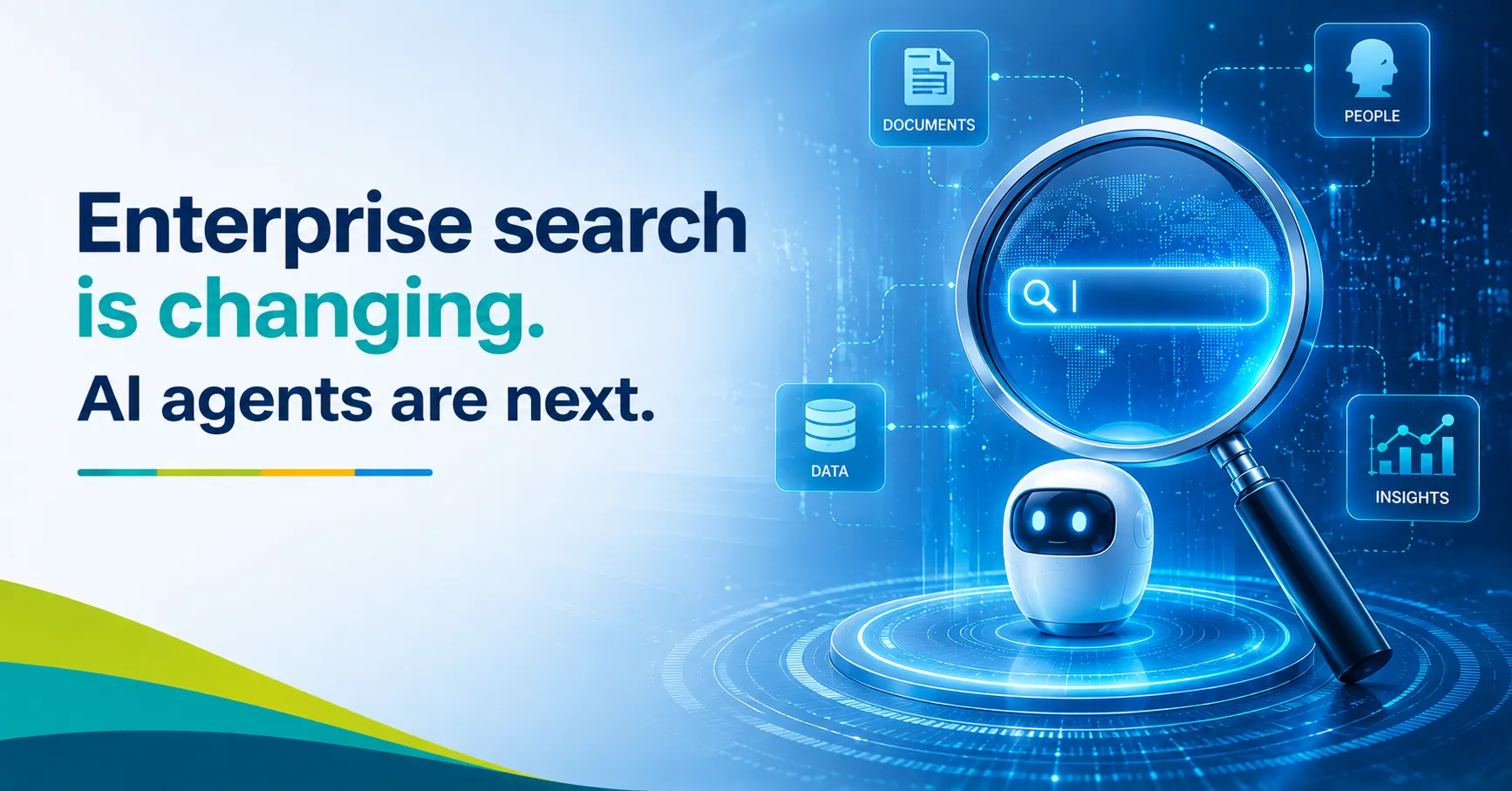
Enterprise AI knowledge management is no longer about adding one more search bar. It is about helping teams find trusted answers, act faster, and reduce knowledge friction across the business.
Most companies do not suffer because knowledge does not exist. They suffer because people cannot reach it when they need it.
A sales leader needs a past pricing exception. A claims manager needs a similar case from five years ago. A support team needs the latest workaround from engineering. A new employee needs to understand how things actually work, not just what the onboarding deck says.
It sits across SharePoint, Google Drive, Slack, Teams, Confluence, Jira, CRM notes, PDFs, emails, service tickets, and old folders no one wants to clean up.
Employees no longer want a list of links. They want answers, context, and next steps. That is where enterprise AI knowledge management starts to matter.
The Productivity Gap No One Wants to Own
Knowledge work has a hidden tax: search time.
Research often shows that knowledge workers spend hours every week searching and gathering information. Even if your company lands below the average, the lost time is still painful at scale.
Search time quietly drains enterprise output.
People ask the same questions in chat. New hires wait for “the person who knows.” Support teams repeat answers. Sales teams rebuild decks. Operations teams hunt for policy updates.
Then someone calls it collaboration. Let’s be honest. A lot of it is waste.
A strong AI-driven knowledge management system helps people find trusted answers faster. When that happens, they stop waiting. They act.
Turn scattered enterprise knowledge into trusted answers.
Explore how Zenxsys Enterprise Knowledge Assistant helps teams search, retrieve, and act on internal knowledge securely.
From Keyword Search to AI Search
Traditional search has one major weakness: it depends too much on the words users type.
If an employee searches “customer refund exception,” but the actual policy says “commercial credit adjustment,” keyword search may miss it. That happens every day in enterprises.
Employees ask messy questions:
AI search works differently. It uses semantic search and language models to understand meaning, not just matching text.
But AI search alone is not enough. A confident wrong answer creates more damage than a slow search result. So the real goal is not just speed. The real goal is trusted speed.
Why RAG Became the Enterprise AI Backbone
Retrieval-Augmented Generation, or RAG, gives enterprise AI a practical architecture.
A normal language model answers based on what it learned during training. That works for general knowledge, but it fails for internal company data.
Your policies, pricing rules, product docs, legal clauses, SOPs, tickets, and project history change constantly.
The user asks a business question in natural language.
The system finds relevant internal content from approved sources.
The model creates an answer using retrieved company context.
The answer includes source links, context, and traceability.
RAG helps companies avoid two common problems: outdated answers and unsupported answers. It gives the model context before it speaks.
That does not make it perfect. Bad retrieval still creates weak answers. Poor chunking still misses context. Messy permissions still create security risk.
Ground your AI answers in enterprise data.
Build AI knowledge systems that retrieve trusted content, respect permissions, and show sources.
GraphRAG: When Your Knowledge Needs Relationships
Standard RAG works well when the answer sits in a clear document chunk. But many enterprise questions need relationships.
GraphRAG helps with questions like:
Plain semantic search may retrieve similar text, but it can miss how entities connect. GraphRAG helps AI understand connections across knowledge, not just similarity between snippets.
In finance, it can connect filings, memos, entities, deals, risks, and approvals. In healthcare, it can connect policies, procedures, case notes, regulations, and patient support workflows. In manufacturing, it can connect plant incidents, maintenance records, SOPs, vendors, and equipment history.
From AI Search to Autonomous AI Agents
AI search answers: “Where is the information?”
AI agents answer: “What needs to happen next?”
AI Search
Finds information, summarizes content, and returns source-linked answers.
AI Assistant
Helps users compare, draft, reason, and make sense of enterprise knowledge.
AI Agent
Uses information to complete tasks, trigger workflows, or recommend next actions.
Finding information is only part of the job. In many workflows, it is the first step. The rest is checking related systems, comparing data, drafting updates, triggering approvals, opening tickets, or preparing reports.
But agents need governance even more than search does. A bad search result wastes time. A bad agent action can change records, email customers, open access, or trigger workflows.
Move from answers to action without losing control.
Design AI agent workflows with permissions, audit logs, human review, and clear business boundaries.
Build vs. Buy: Choosing the Right Enterprise AI Path
Leaders often ask whether they should build or buy. The honest answer: it depends on your data risk, speed needs, internal talent, and workflow complexity.
Buy when you need speed
Choose a platform when you need broad workplace search, faster rollout, existing connectors, and lower internal engineering load.
Build when control matters
Build when you need custom workflows, strict data sovereignty, air-gapped deployment, or deep domain-specific logic.
Choose based on operating reality:
The best choice is not the flashiest platform. It is the one your teams will trust, adopt, and govern.
Security and Governance: The Conversation Backdoor Risk
Enterprise AI creates a new risk: the conversation backdoor.
A user may not have access to a confidential document directly. But if an AI system retrieves that document and summarizes it in chat, security has failed.
AI must never bypass source-level access controls.
If a user cannot access a file in SharePoint, Confluence, Drive, GitHub, or a ticketing system, the AI answer should not expose it either.
Permissions need to become first-class data. Authorization should happen before retrieval, not after the answer gets generated.
Verify the user, role, and business context.
Track sources, permissions, and retrieved content.
Log the answer, action, handoff, or workflow result.
If you cannot audit that, you do not have enterprise-grade AI. You have a risk channel.
Build AI knowledge systems with governance from day one.
Zenxsys helps enterprises design secure RAG systems, governed AI assistants, and knowledge workflows.
How to Measure AI Knowledge Management Properly
Many AI projects fail because teams measure them with vibes.
People say, “The answer looks good.” That is not enough.
Faithfulness
Did the answer stay true to the retrieved content?
Answer Relevancy
Did the answer address the actual question?
Context Precision
Did the system rank the best chunks first?
Context Recall
Did the system find enough supporting information?
You also need business metrics: search time saved, query success rate, citation click-through, repeated questions reduced, onboarding time improved, ticket deflection, agent task completion, and human escalation rates.
AI value does not come from usage alone. It comes from better decisions, faster execution, and lower friction.
Industry Examples: Where Enterprise AI Is Already Working
The best enterprise AI use cases start with a real workflow pain.
Employee Knowledge
Centralize knowledge across Slack, Confluence, GitLab, Google Drive, and internal tools.
Media Archives
Help editorial teams search, summarize, and retrieve historical material faster.
Insurance Claims
Help claims experts explore historical cases, policy language, and decision context.
Good enterprise AI does not remove human expertise. It gives experts a better starting point.
How Leaders Should Start Without Overbuilding
The worst way to start is by trying to “AI-enable everything.” That creates noise, scattered pilots, and weak adoption.
Start where knowledge friction costs real money. Pick one workflow where teams already feel pain: support resolution, sales research, employee onboarding, policy lookup, claims research, engineering knowledge, or compliance review.
Pick one painful workflow
Start with a use case where search delays create business impact.
Map the data sources
Identify where the real knowledge lives and who owns it.
Clean the access model
Make sure permissions work before retrieval starts.
Measure answer quality
Track faithfulness, relevancy, precision, and recall.
Expand after trust
Move from search to answers, then from answers to agents.
Search first. Answers next. Agents after trust.
Ready to make enterprise knowledge usable, secure, and actionable?
Zenxsys helps enterprises build AI knowledge systems that connect scattered data, respect permissions, reduce search time, and support better decisions.
Explore EKA