
Healthcare Data · Supported
HIPAA Security Rule
HIPAA Security Rule - Health Insurance Portability and Accountability Act
HIPAA Security Rule
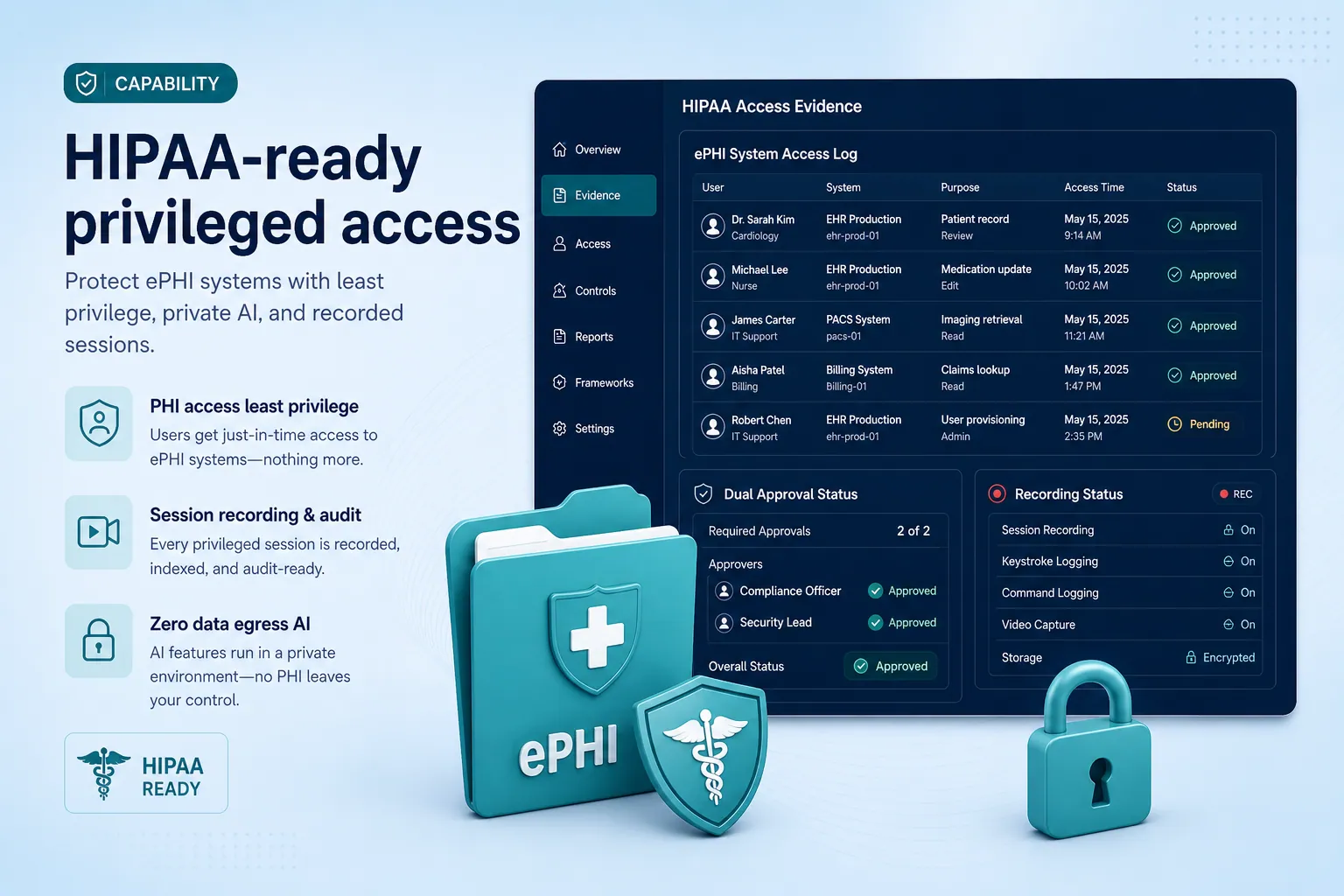
The HIPAA Security Rule requires technical safeguards over systems holding electronic protected health information. ZenXPAM seeds the framework and maps its controls to named implementation specifications such as §164.312(d), evidencing unique identification, authentication and audit control over privileged access to ePHI systems.
- Mapping to named §164.308 and §164.312 implementation specifications
- Continuous automated checks with a HIPAA Security Rule score
- Access certification campaigns over accounts that can reach ePHI
- Hash-chained audit controls covering every privileged session
What is HIPAA Security Rule?
HIPAA (Health Insurance Portability and Accountability Act) is a U.S. federal law enacted in 1996 that establishes national standards for protecting sensitive patient health information. The HIPAA Privacy Rule and Security Rule require covered entities and their business associates to implement safeguards to ensure the confidentiality, integrity, and availability of Protected Health Information (PHI). HIPAA applies to individually identifiable health information held or transmitted by covered entities or their business associates, in any form or medium. The law requires organizations to implement administrative, physical, and technical safeguards to protect PHI, conduct risk assessments, implement access controls, encrypt data, and maintain audit logs. HIPAA also grants patients rights over their health information, including the right to access, amend, and receive an accounting of disclosures of their PHI.
Where is HIPAA Security Rule applicable?
HIPAA compliance is mandatory for covered entities and their business associates in the United States. Covered entities include healthcare providers (doctors, clinics, hospitals, nursing homes, pharmacies), health plans (health insurance companies, HMOs, company health plans, government programs like Medicare and Medicaid), and healthcare clearinghouses (entities that process nonstandard health information). Business associates are third-party vendors or contractors who create, receive, maintain, or transmit PHI on behalf of covered entities, including IT service providers, cloud storage companies, billing services, and software vendors. Any organization that handles PHI, even if not directly providing healthcare services, must comply with HIPAA. This includes technology companies providing healthcare software, cloud services storing medical records, and any service provider working with healthcare organizations. HIPAA applies regardless of organization size, from small medical practices to large hospital systems.
Features, benefits & risks
Key Features
- Mapping to named §164.308 and §164.312 implementation specifications
- Continuous automated checks with a HIPAA Security Rule score
- Access certification campaigns over accounts that can reach ePHI
- Hash-chained audit controls covering every privileged session
- Signed evidence packs with an offline verifier for assessors
Benefits
- Evidences technical safeguards over ePHI system access
- Removes standing administrative access to clinical systems
- Supports business associate obligations with exportable evidence
- Shortens risk analysis and assessment preparation
- Keeps session content and AI processing inside your deployment
Risks
- Fines up to $1.5 million per violation category per year for non-compliance
- Criminal penalties including imprisonment for willful violations
- Loss of ability to serve healthcare clients and process PHI
- Legal liability from unauthorized PHI disclosure
- Reputation damage and loss of healthcare industry trust