
Data Privacy · Supported
GDPR
General Data Protection Regulation
GDPR
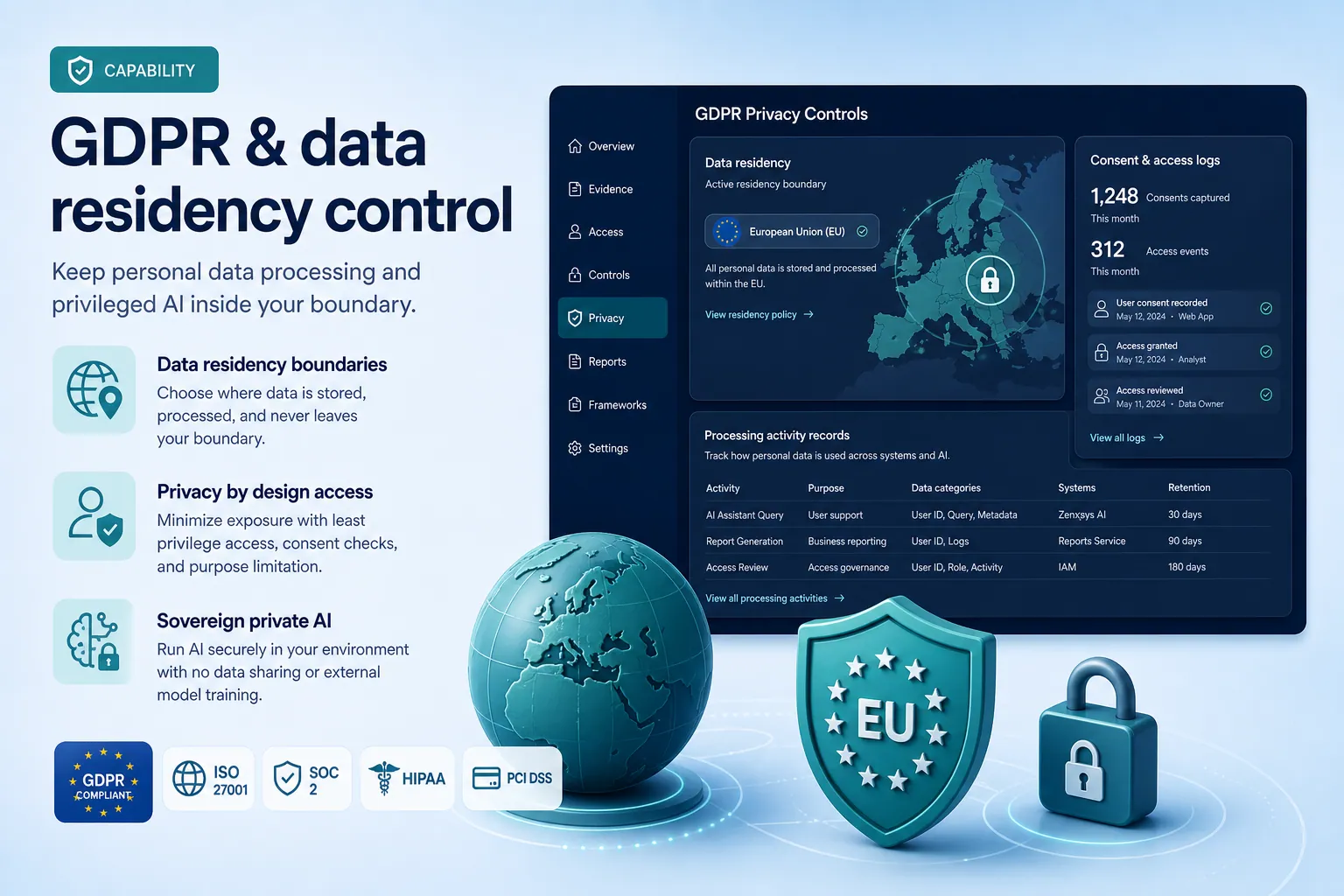
GDPR holds controllers and processors to demonstrable control over who can reach personal data. ZenXPAM seeds the framework, maps privileged access controls to the relevant articles, and evidences that access to systems holding personal data was requested, approved, time-boxed and recorded. GDPR compliance remains the deploying organisation's responsibility.
- Article-level mapping of access, integrity and accountability controls
- Continuous automated checks with a GDPR score and drill-down
- Access certification campaigns over accounts that can reach personal data
- Hash-chained audit supporting breach investigation and accountability
What is GDPR?
GDPR (General Data Protection Regulation) is a comprehensive data protection law that came into effect in the European Union in May 2018. It is designed to give EU citizens more control over their personal data and to simplify the regulatory environment for international business. GDPR establishes strict rules for how personal data must be collected, processed, stored, and protected. It grants individuals significant rights over their data, including the right to access, rectify, erase, and port their personal information. The regulation also mandates that organizations implement privacy by design and default, conduct data protection impact assessments, and report data breaches within 72 hours. GDPR applies to any organization that processes personal data of EU residents, regardless of where the organization is located.
Where is GDPR applicable?
GDPR compliance is applicable to any organization that processes personal data of individuals located in the European Union, regardless of where the organization is based. This includes companies that offer goods or services to EU residents, monitor the behavior of EU residents, or process personal data of EU citizens. The regulation applies to both data controllers (organizations that determine why and how personal data is processed) and data processors (organizations that process data on behalf of controllers). This means virtually any business with EU customers, employees, or website visitors must comply with GDPR. It applies across all industries, from e-commerce and technology to healthcare, finance, and marketing. Non-EU companies must also comply if they handle EU residents' data.
Features, benefits & risks
Key Features
- Article-level mapping of access, integrity and accountability controls
- Continuous automated checks with a GDPR score and drill-down
- Access certification campaigns over accounts that can reach personal data
- Hash-chained audit supporting breach investigation and accountability
- AI runs on local models inside your deployment, local provider enforced in production
Benefits
- Demonstrable control over who reached personal data, and when
- Supports data protection by design in privileged access paths
- Keeps session context and audit data inside your own perimeter
- Gives DPOs evidence without a manual log reconstruction
- Supports processor obligations toward controller customers
Risks
- Fines up to €20 million or 4% of annual global turnover for non-compliance
- Loss of ability to process EU residents' personal data
- Legal liability from data breaches and privacy violations
- Reputation damage from privacy incidents
- Restricted access to EU markets and customers