
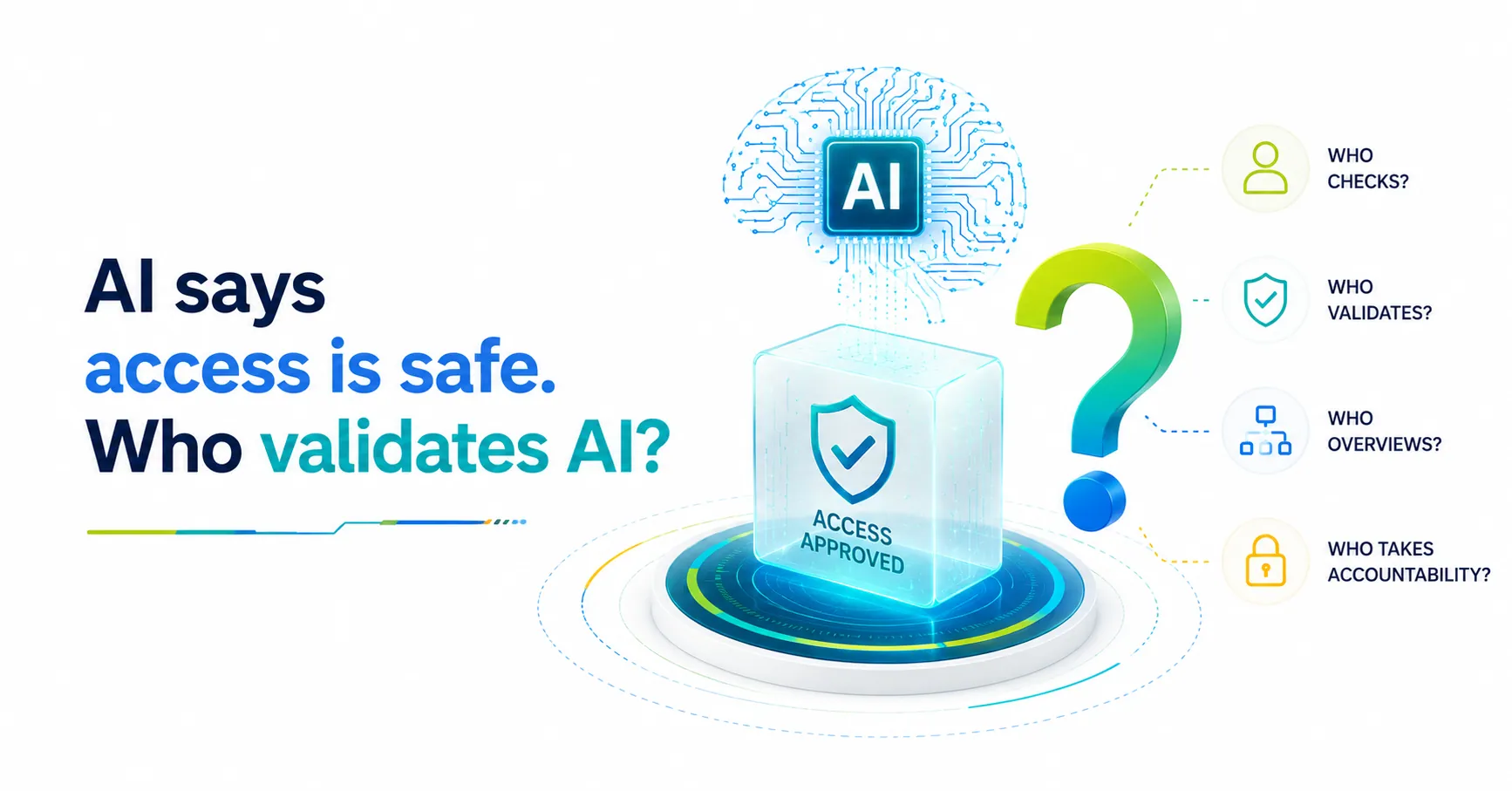
If AI is deciding which privileges are safe, who is validating the model?
That question is becoming harder for CISOs to avoid.
AI in privileged access management is no longer a future concept. It is already showing up in risk-based authentication, behavioural analytics, just-in-time access, entitlement discovery, privileged session monitoring, and SOC investigation workflows.
The problem is not that AI is entering IAM and PAM.
The problem is that many organisations are letting AI influence privileged access decisions without treating the model itself as a security control.
And privileged access is not an ordinary control.
When privileged access fails, the impact is expensive. A wrong decision can lead to a breach, outage, compliance failure, or a silent expansion of toxic access.
That is why the real question is not, “Do we have AI in IAM?”
The better question is, “Who validates the AI before it changes, blocks, grants, or recommends privileged access?”
Quick Answers: AI, IAM and Privileged Access Risk
What is AI in IAM?
AI in IAM means using artificial intelligence or machine learning to support identity and access decisions. This can include detecting unusual login behaviour, recommending access changes, identifying risky entitlements, or supporting role discovery.
Why is AI risky in privileged access management?
AI is risky in privileged access management because privileged accounts can change systems, access sensitive data, and override normal controls. If the AI model makes a wrong judgement, it may allow risky access or block legitimate emergency work.
What are AI hallucinations in cybersecurity?
AI hallucinations in cybersecurity are confident but incorrect outputs from AI systems. In identity security, this could mean a wrong summary of a privileged session, a missed risky command, or an inaccurate explanation of why access was approved.
What is AI model governance?
AI model governance is the set of roles, controls, validation steps, monitoring processes, and accountability rules used to manage AI systems. For IAM and PAM, it means proving that the model is suitable, tested, monitored, and kept within clear guardrails.
Should AI fully automate privileged access decisions?
For high-impact accounts, full automation should be limited. AI can recommend, score, and flag risk, but human approval should remain mandatory for admin roles, root-equivalent access, Tier-0 systems, and structural policy changes.
Where AI Is Already Making Privilege Decisions
Many organisations do not openly say, “AI decides access.”
But the reality is more subtle.
AI is already influencing access decisions through scoring, recommendations, anomaly detection, and automated workflow triggers. Even when a human clicks the final approval button, the AI-generated risk score often shapes the outcome.
That influence matters.
Especially when the decision involves privileged access.
Behavioural Analytics for Privileged Accounts
Modern IAM and PAM platforms use behavioural analytics to understand how users, admins, and service accounts normally behave.
The model may look at:
- login time
- device type
- location
- command pattern
- session duration
- frequency of access
- data touched
- systems accessed
- historical admin behaviour
If an administrator logs in from a new country, runs unusual commands, or accesses systems outside the normal pattern, the model may raise the risk score.
That score can then trigger step-up authentication, session recording, approval workflows, or blocking actions.
On paper, this is useful.
In practice, the model is now part of the privileged access control path.
Risk-Based Authentication and Just-in-Time Access
Risk-based authentication uses signals to decide how much friction to apply during login or access elevation.
Just-in-time access gives temporary elevated privileges only when needed.
AI can improve both.
For example, a database admin may request production access for 30 minutes. The system checks role, location, past behaviour, ticket context, device posture, and current threat signals. Then it calculates whether the request looks safe.
The decision may not be based only on static policy.
It may be based on an AI-calculated risk score.
That creates a new governance question.
Who approved the model’s logic?
AI-Assisted Role and Entitlement Discovery
Least privilege sounds simple: give people only the access they need.
At enterprise scale, it is painful.
Large organisations have thousands of roles, millions of entitlements, old exceptions, inherited access, orphaned accounts, and “temporary” access that became permanent.
AI-assisted role discovery tries to solve this by analysing access patterns and recommending role changes.
It may suggest:
- which entitlements are unused
- which roles can be merged
- which access should be removed
- which access looks normal for a peer group
- which users need additional privileges
This can help identity teams move faster.
But it can also automate old mistakes.
If the model is trained on messy access data, it may treat over-privilege as normal.
AI in SOC Tooling
SOC teams also use AI to summarise alerts, correlate logs, explain incidents, and recommend response actions.
When the incident involves privileged misuse, AI-generated summaries can influence how quickly the team reacts.
A summary may say:
“Admin activity appears consistent with normal maintenance.”
Or:
“Privilege escalation followed a known support workflow.”
If that summary is wrong, the investigation may go in the wrong direction.
The SOC analyst still owns the decision.
But the AI has shaped the judgement.
specially true with generative AI.
AI hallucinations in cybersecurity are not just a user experience issue. They can become a control failure when analysts, auditors, or access reviewers rely on AI-generated explanations.
In privileged access, there are two failure modes security leaders should worry about.
False Negatives: Risk Classified as Safe
A false negative happens when risky activity is classified as low risk.
In PAM, this could look like:
- a service account accessing sensitive systems outside its normal scope
- an admin exporting large data sets slowly over time
- a toxic combination of privileges being treated as acceptable
- unusual commands being hidden inside a long session
- a dormant privileged account being used after months of inactivity
False negatives are dangerous because they create confidence.
The system looks calm.
The dashboard is green.
The alert never fires.
But the risk continues.
False Positives: Legitimate Work Blocked
A false positive happens when legitimate activity is treated as dangerous.
In privileged access, this can also hurt the business.
Imagine an emergency incident where infrastructure teams need elevated access to restore production systems. If an AI model blocks the request because the behaviour looks unusual, the result could be delay, outage, and frustration.
When this happens repeatedly, administrators ask for bypass accounts.
Bypass accounts become the real risk.
So the challenge is not simply “make AI stricter.”
The challenge is to make AI trustworthy, explainable, and governed.
How AI Can Automate Legacy Privilege Risk
AI models learn from data.
That sounds obvious.
But in IAM and PAM, historical data is often messy.
Many organisations have years of accumulated access debt:
- over-privileged admin groups
- old vendor access
- emergency access never revoked
- shared service accounts
- weak role design
- exception-based approvals
- local admin rights nobody owns
- privileged accounts outside PAM coverage
If AI learns from this data without strong validation, it may treat broken access patterns as normal.
That is not least privilege.
That is automation of legacy risk.
Example: The Over-Privileged DevOps Group
Consider a DevOps group that has broad access across production, staging, cloud consoles, deployment tools, secrets, and monitoring systems.
Historically, this access was granted because the team needed speed.
Over time, nobody cleaned it up.
An AI model analysing access patterns may conclude:
“Members of this group commonly use broad production access. This is normal behaviour.”
The model may then recommend similar access for new DevOps users.
It may also avoid flagging risky activity because the baseline itself is already too broad.
The organisation wanted least privilege discovery.
It got automated approval of yesterday’s mess.
Example: Temporary Access That Became Baseline
A vendor receives privileged access for a six-week project.
The access is not revoked.
Six months later, the vendor account still logs in occasionally.
If the AI model sees enough of this activity, it may classify the access pattern as normal.
The business calls it temporary.
The model calls it baseline.
The attacker calls it opportunity.
AI Hallucinations, Summaries and Audit Blindness
Generative AI is now being used to summarise long privileged sessions, command histories, audit logs, and investigation evidence.
This is understandable.
No auditor wants to manually read thousands of lines of session logs.
No SOC analyst wants to inspect every command from a six-hour admin session.
AI summaries can save time.
But they also create a new blind spot.
If the model omits a critical command, mislabels a sensitive action, or produces a confident but incomplete explanation, reviewers may miss the real issue.
For example, an AI-generated audit summary may say:
“User performed routine database maintenance.”
But the raw session may include:
- privilege escalation
- data export
- configuration changes
- disabling of monitoring
- creation of a new privileged account
If those details are omitted, audit confidence becomes artificial.
The summary looks clean.
The evidence is not.
There is also a data sensitivity problem.
Privileged logs and session recordings can contain secrets, commands, customer data, infrastructure paths, credentials, and internal system architecture. Feeding that content into an LLM without strict controls can create a data exposure risk.
For PAM teams, the rule should be simple:
AI can summarise audit evidence, but it should never replace audit evidence.
What Proper AI Model Governance Looks Like for IAM and PAM
AI model governance means defining how models are built, validated, deployed, monitored, changed, and retired.
For IAM and PAM, this cannot be a generic AI policy sitting in a compliance folder.
It must be connected to access control.
A model that influences privileged access should be treated as a high-risk model.
Why?
Because it can affect:
- who receives elevated access
- when access is blocked
- which entitlement is removed
- which session is flagged
- which alert is escalated
- which audit evidence is trusted
That is too important to manage casually.
Governance Should Cover the Full Model Lifecycle
A practical AI model governance process for IAM and PAM should include:
- documented model purpose
- approved use cases
- clear risk rating
- training data review
- feature review
- validation before deployment
- testing against edge cases
- production monitoring
- drift detection
- change approvals
- periodic review
- incident response process
- retirement criteria
This sounds heavy.
But for privileged access, it is necessary.
The financial sector has treated model risk seriously for years. The same thinking now belongs in identity security. A model that affects admin access should face independent validation, documented assumptions, and periodic review.
Not because governance is fashionable.
Because privileged access is too powerful to be delegated to an unvalidated black box.
Who Should Validate the Model?
The answer should not be: “The same team that built it.”
That violates basic separation of duties.
AI-driven IAM needs clear ownership across three groups.
Model Builders
Model builders may include vendors, data science teams, engineering teams, or product teams.
They are responsible for:
- model design
- training approach
- feature selection
- model performance
- technical documentation
- known limitations
- model update process
They should explain how the model works in practical terms.
Not every security leader needs mathematical detail.
But the IAM team should understand what signals drive the model’s decisions.
Control Owners
The IAM and PAM teams are control owners.
They decide where model outputs can influence access decisions.
For example:
- Can AI only recommend access removal?
- Can AI trigger step-up authentication?
- Can AI block privileged access?
- Can AI auto-approve low-risk requests?
- Can AI revoke entitlements?
- Can AI change standing access policies?
These are not vendor decisions.
These are control-owner decisions.
The PAM team must define the red lines.
Independent Validators
Independent validators may come from risk, internal audit, security assurance, compliance, or external assessors.
Their job is to challenge the model.
They should test:
- assumptions
- edge cases
- biased baselines
- noisy training data
- false positive scenarios
- false negative scenarios
- explainability
- monitoring controls
- rollback procedures
The validator should not simply ask, “Does the tool work?”
They should ask, “Can we trust this model enough to influence privileged access?”
That is a higher bar.
Human-in-the-Loop vs Full Automation
There is a big difference between AI as decision support and AI as decision maker.
Decision support means AI helps humans make better choices.
Decision maker means AI executes the access decision on its own.
In privileged access, that line matters.
A pragmatic approach looks like this:
AI can:
- score access risk
- flag anomalies
- recommend entitlement cleanup
- summarise session activity
- suggest approval context
- identify dormant privileges
- propose role changes
Humans should approve:
- Tier-0 access changes
- domain admin access
- root-equivalent access
- emergency admin elevation
- structural role redesign
- access to production systems
- access involving regulated data
- policy changes affecting large groups
One rule should be explicit:
No model should silently grant or revoke domain admin, root-equivalent, or high-impact privileged access.
If the access can materially affect the business, a human must be in the loop.
Threat Scenarios That Make the Risk Real
AI-driven identity decisions can look smart on dashboards. But when the model learns from weak access patterns, bad logs, or incomplete evidence, the risk becomes operational.
Scenario 1: The Quiet Insider
An employee slowly downloads sensitive files over months.
The activity is never dramatic. No huge spike. No obvious abuse.
The AI model sees the behaviour repeatedly and starts treating it as normal.
Later, when the same pattern appears again, the model does not flag it.
Scenario 2: The Over-Zealous AI During an Incident
A production outage hits. Admins request emergency access.
The AI model blocks the request because the behaviour is unusual, the time is abnormal, and the system risk score is high.
Technically, the model is doing its job. Operationally, it is making things worse.
After the incident, administrators demand permanent bypass accounts.
Scenario 3: The Poisoned Training Set
A bad data source enters the model pipeline.
Logs are incomplete. Some attack patterns are missing. Some privileged actions are mislabelled.
The model learns from this poor-quality data and starts under-scoring specific risky behaviours.
Scenario 4: The AI-Generated Audit Blind Spot
An auditor reviews AI-generated summaries of privileged sessions.
The summaries are clean. But the raw logs include sensitive commands that were omitted.
Nobody checks the full evidence because the summary looked confident.
Practical Checklist for CISOs and IAM Leaders
Before expanding AI in IAM or PAM, security leaders should ask these questions. The goal is simple: know which models influence access, who owns them, and where human validation is required.
Model Inventory
- Which AI or ML models influence access decisions today?
- Which models affect privileged access directly or indirectly?
- Which tools use AI for risk scoring, anomaly detection, entitlement discovery, or session summaries?
Ownership
- Who owns the model purpose?
- Who owns training data quality?
- Who approves production changes?
- Who signs off before the model influences privileged access?
Validation
- Has the model been independently validated?
- Have false positives and false negatives been tested?
- Have emergency access scenarios been tested?
- Have insider threat scenarios been tested?
- Have toxic entitlement combinations been tested?
Automation Boundaries
- Where can AI only recommend?
- Where can AI block?
- Where can AI approve?
- Where is human approval mandatory by design?
- Can the model grant, revoke, or change privileged access without review?
Monitoring
- How do we detect model drift?
- How do we detect hallucinated or incomplete summaries?
- How do we review model decisions after incidents?
- How do we roll back a model that behaves badly?
Board and Regulator Readiness
- If the board asks who validated the model, do we have a clear answer?
- If a regulator asks why privileged access was approved, can we explain it?
- If a breach happens, can we prove the model was governed, tested, and monitored?
Conclusion: AI as a Privilege Co-Pilot, Not the Pilot
AI belongs in IAM and PAM.
It can help security teams detect unusual behaviour, reduce manual reviews, clean up access sprawl, and move closer to least privilege.
But AI in privileged access management should not become blind automation.
The strongest organisations will not be the ones that simply say, “We use AI in IAM.”
They will be the ones that can prove their AI is governed, validated, monitored, and kept inside human-approved guardrails.
That is the real advantage.
Not AI for access.
Trustworthy AI for access.
So the question remains:
If AI is deciding which privileges are safe in your organisation, who exactly is validating the model?
FAQ: AI in Privileged Access Management
What is AI in privileged access management?
AI in privileged access management means using AI or machine learning to support privileged access decisions, risk scoring, anomaly detection, and session review. It helps PAM teams identify unusual admin behaviour, risky entitlement patterns, dormant privileged accounts, and access activity that does not match normal behaviour. However, AI in PAM should not be treated as a fully trusted decision maker without proper validation. For high-risk privileged access, human approval and strong AI model governance are still essential.
Why does AI model governance matter in PAM?
AI model governance matters in PAM because privileged access controls protect critical systems, sensitive data, administrative accounts, and production environments. If an AI model influences who gets access, when access is blocked, or which privileges are removed, the model becomes part of the security control path. Without proper validation, AI in privileged access management can create false positives, false negatives, audit gaps, and risky automation. CISOs should treat these models as high-risk models that need testing, monitoring, explainability, and clear ownership.
What are AI hallucinations in cybersecurity?
AI hallucinations in cybersecurity are confident but incorrect outputs generated by AI systems or large language models. In IAM and PAM environments, this could mean an inaccurate privileged session summary, a missed risky command, or a wrong explanation for an access decision. These hallucinations can mislead SOC teams, auditors, IAM teams, and identity security leaders if they rely only on AI-generated summaries. That is why raw logs, session recordings, access evidence, and human review must remain part of privileged access governance.
Should AI be allowed to revoke admin access automatically?
AI should be used very carefully when revoking admin access or changing privileged permissions automatically. For low-risk recommendations, AI can help identify unused access, toxic entitlement combinations, policy violations, and entitlement clean-up opportunities. But for domain admin, root-equivalent access, Tier-0 systems, production environments, and emergency access, human approval should be mandatory. A strong identity security and AI strategy should use AI as a co-pilot, not as the final authority for privileged access decisions.
What should CISOs ask vendors about AI in IAM?
CISOs should ask vendors how AI in IAM is trained, what data sources are used, and how access risk scores are calculated. They should also ask whether the AI model can approve, deny, revoke, or recommend privileged access changes without human review. Vendors should clearly explain model validation, false positive testing, false negative testing, model drift monitoring, audit reporting, and governance controls. If a vendor cannot explain how its AI model governance works, the organisation should be careful before using it for privileged access decisions.