
Privileged Access
Intent-Locked Privileged Sessions: Enforcing What Was Approved
Recording a session tells you about a violation afterwards. This paper explains how a written justification becomes an approved command scope, enforced at the target and provable in an audit.
Zenxsys · September 23, 2026 · 8 min read
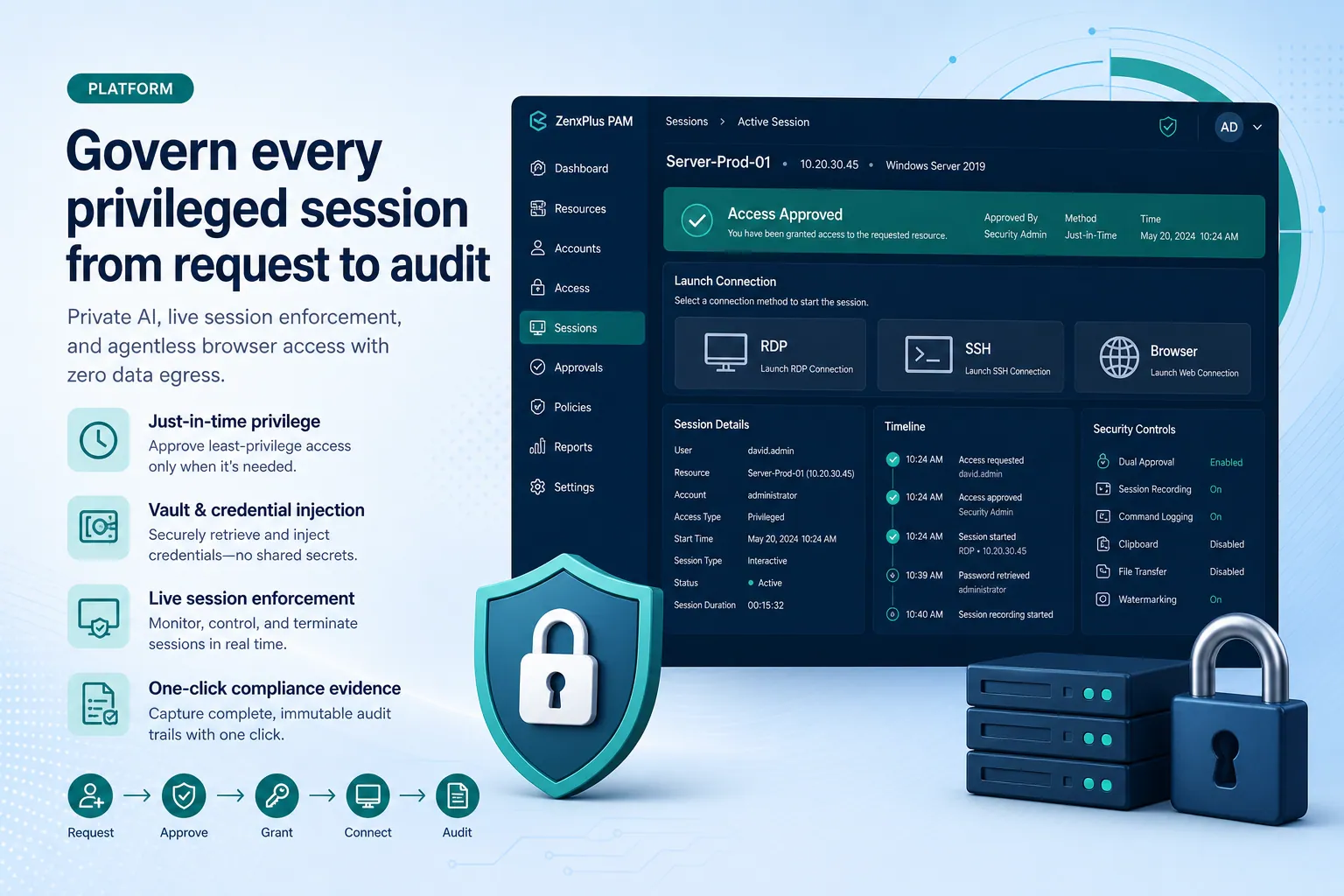
Every privileged access management product on the market records what an administrator did. The recording is reviewed after an incident, which means the control is detective: it tells you about a violation once the violation has already happened. Intent-locked sessions close that gap by holding the session to the scope an approver actually authorised.
How it works
When an operator requests privileged access, they write a justification - for example, "restart PostgreSQL on db-01". ZenXPAM compiles that sentence into a machine-enforceable scope: a set of allowed and denied command patterns, typed by capability. The approver sees that compiled scope alongside the request, edits it if it is too broad, and approves the scope rather than a vague intention.
The scope then travels with the session to the target. On a Linux shell session, a kernel-level eBPF-LSM program gates program execution at execve inside the session's control group, so an out-of-scope binary never runs. On a database session, a SQL proxy evaluates each statement before it reaches the engine. Every block is recorded as an event in its own right.
Being honest about coverage
Enforcement is only as good as the transport allows, so ZenXPAM labels every session for what it actually is:
- Preventive - Linux shell, SSH and jump-server application sessions, gated in the kernel; and database sessions, gated at the query proxy.
- Detective - RDP, browser and other transports, where activity is reconstructed from keystroke and session capture and risk-scored, but not blocked at the target.
A control you cannot describe precisely is a control an auditor will not accept. Preventive mode also requires an agent on the target host and a kernel boot parameter, so it is planned into a deployment rather than switched on globally.
From enforcement to evidence
The value of enforcing a scope is that it changes what you can prove. Instead of "we log privileged access", the claim becomes "privileged activity stayed inside what was approved, and here is the signed evidence". Session evidence is signed with ES256, hash-chained into the audit trail, and mapped to control clauses in SOC 2, ISO 27001, PCI DSS, NIST 800-53 and DORA. An offline verifier lets an auditor check the pack without access to - or trust in - the platform that produced it.
Where to start
Most teams begin with a single high-consequence estate: production database administration, or third-party vendor access. Put those sessions behind a request and an approved scope, run them preventively where the transport supports it, and take the signed evidence to the next audit. The operational change is small; the change in what you can demonstrate is not.
Talk to us if you would like to see an out-of-scope command blocked in a live session, and verify the resulting evidence pack yourself.