Passwords Know Who; Intent Knows Why
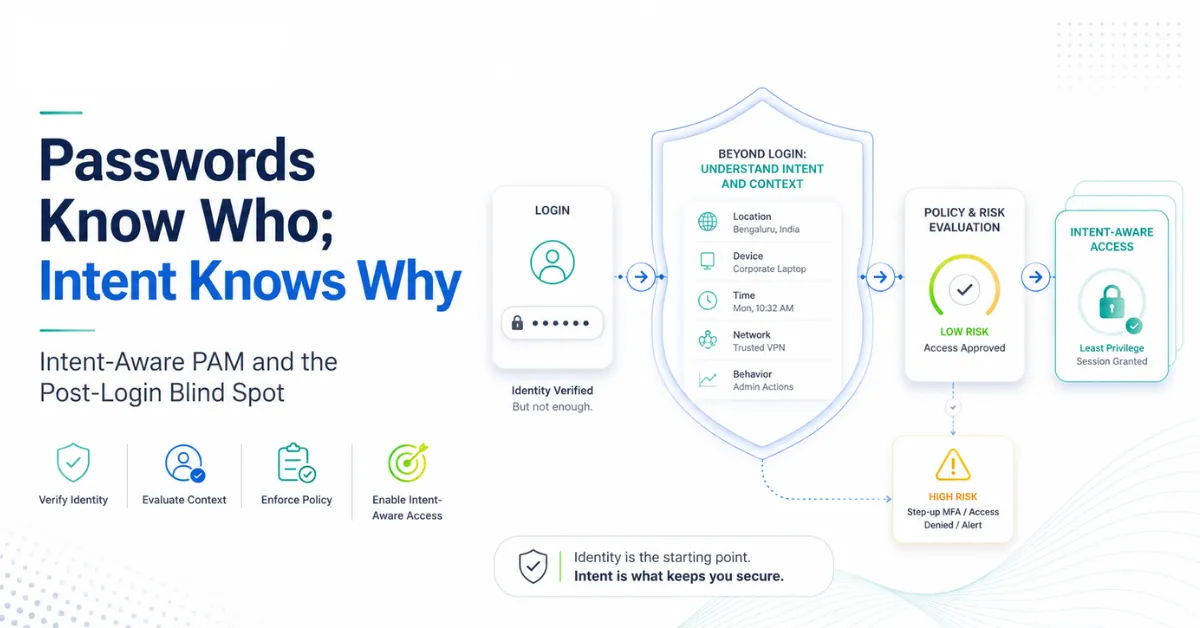
PAM stops at “access granted.” Attackers do not. The next privileged access problem is not only who gets in, but whether their actions still match the purpose of access.
Modern PAM does a strong job of reducing attack surface. It vaults passwords. It rotates credentials. It records sessions. It forces approvals. It gives security teams a better grip on privileged access.
But once access is granted, visibility often becomes weaker. The system knows who logged in. It may know which server they touched. It may record the session. But does it know why they are there?
Passwords know who. Intent knows why.
That is the post-login blind spot. Traditional systems see commands, clicks, and connection events. They do not always understand purpose. A routine configuration change and a malicious data export can look similar until the damage is already done.
Quick FAQs on Intent-Aware PAM
What is Intent-Aware PAM?
Intent-Aware PAM checks not only who is requesting access, but why access is needed. It uses identity, context, resource, action, risk, and purpose.
What is the post-login blind spot?
It is the gap after a user gets valid access. Traditional PAM may approve the session but miss whether actions still match the approved purpose.
What is intent lockout?
Intent lockout is a two-sided failure. Bad intent gets through because credentials are valid, while good intent gets blocked by rigid policies.
Why does AI agent security make this harder?
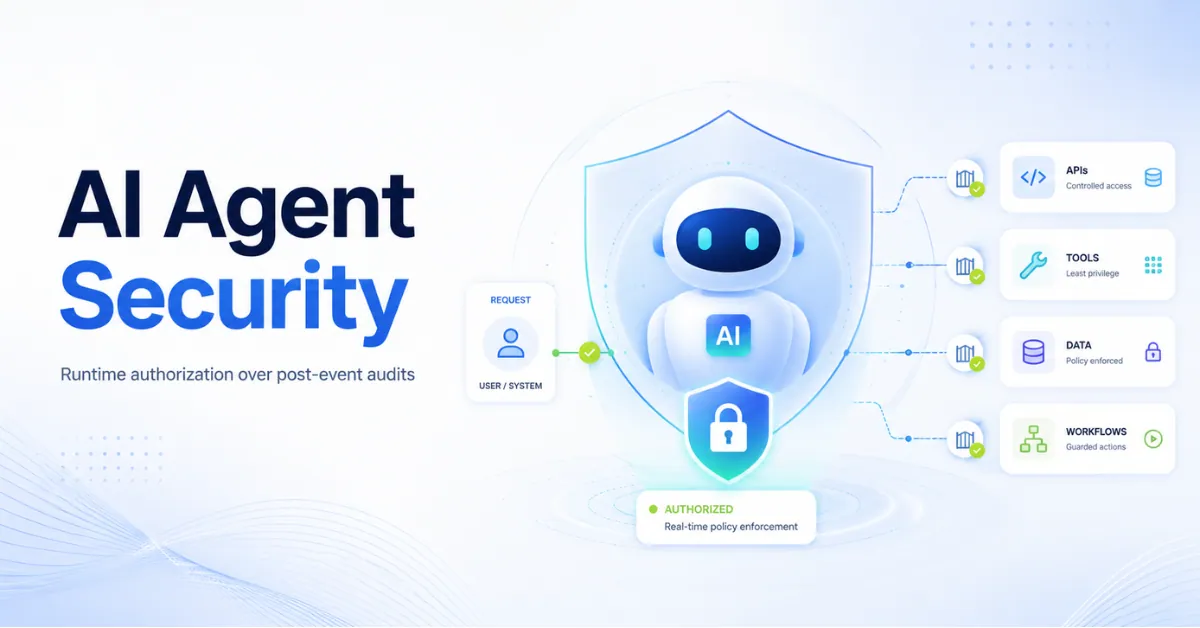
AI agents can call tools, access data, and act across systems at runtime. They may pass permission checks but still fail the intent check.
The Identity Trap: Why “Who” Is Not Enough
Knowing who is connecting is important. It is not enough.
Identity tells you the actor. It does not prove the purpose. A valid admin account can perform a valid command for an invalid reason. A trusted engineer can become compromised. A contractor can keep access after a project ends. A service account can carry permissions from a migration completed years ago.
This is the identity trap. Security teams often treat authentication as the main event. Once the user passes MFA and checks out a credential, the session receives a level of trust that may not match the actual risk.
The better question is not only: “Who is this user?”
The sharper question is: “Does this action still match the reason access was granted?”
Privilege Sprawl Turns Old Intent Into New Risk
Privilege sprawl is not only a permissions problem. It is an intent decay problem.
Many privileges were created for a real reason at the time. A migration. A release. A vendor project. A production issue. A temporary admin task. Then the work ended, but the privilege remained.
Access starts as business need. It becomes technical debt. Then it becomes an attacker’s shortcut.
Every orphaned admin role, stale service account, and overbroad entitlement reflects a past intent that no longer exists. Traditional PAM can vault the credential, but vaulting does not fix the wrong permission model.
Close the post-login blind spot
Zenxsys helps security teams rethink privileged access beyond passwords, vaults, and static approvals.
The Two Sides of Intent Lockout
Intent lockout is a useful way to describe a common security failure. It works in two directions.
Bad Intent Is Not Locked Out
A malicious insider or attacker with valid credentials may pass every login and access check. The system sees an approved user, a known account, and normal tools.
But it does not see that the user is exporting data instead of performing maintenance. It does not see that the admin is touching systems outside the approved change. It does not see that the session has shifted from operational work to reconnaissance.
Good Intent Gets Locked Out
The other side is just as painful. Legitimate engineers get blocked by rigid workflows. Operators get stuck in approval queues during incidents. DevOps teams lose time because policies do not understand change windows or emergency fixes.
A control that cannot tell the difference between risky behavior and urgent operational work will eventually be bypassed.
The RDP Timeout Trap
Picture a common admin workflow. An engineer connects through RDP to fix a domain issue. The session times out. The PAM system rotates the password. Now the engineer is locked out of the same domain they were trying to repair.
The tool followed policy. But it missed intent.
The session timeout was treated as a clean end of work. The system did not understand that the user was still in the middle of a repair task. It did not connect the access decision to the operational purpose.
Rigid PAM asks, “Did the timer expire?” Intent-aware control asks, “Is the task still valid?”
AI Agent Security: “Allowed To” Is Not the Same as “Meant To”
AI agents make the intent problem bigger. A human user usually knows the task. An AI agent may break the task into steps at runtime. It may call tools, fetch data, trigger workflows, query APIs, and act across systems.
Static role assignments cannot fully describe that risk.
An agent may be allowed to access a ticketing system. It may also be allowed to query a customer database. It may have permission to call an internal API. Each action may pass a permission check.
But the chain of actions may go far beyond the original intent.
Your agents may pass every permission check, but still fail the intent check.
Non-human identity PAM must move beyond static permissions. It needs runtime intent evaluation, task boundaries, tool-level control, and clear audit trails.
The Intent Tuple: Who, What, Resource, Constraint
Intent-aware control needs a simple model. One useful model is the intent tuple.
Who
Which user, service, agent, or pipeline is acting?
What
Which action is being requested or performed?
Resource
Which system, dataset, API, or privileged asset is affected?
Constraint
Which limits define safe use, such as time, device, ticket, or scope?
A database administrator requesting read-only access to production logs for a specific incident ticket, from a trusted device, for 60 minutes, is very different from the same admin exporting large volumes of customer records outside the change window.
Same identity. Different intent. Different risk. Different decision.
Multi-Point Enforcement: Prompt, Data, Tool
Intent cannot be checked only once. Policy should apply at several points.
Prompt or Request
What is the user or agent trying to achieve? Is the request tied to an approved task, ticket, or business process?
Data Access
Does this task require customer data, secrets, logs, source code, financial data, or production configuration?
Tool Invocation
Can this identity run this command, call this API, change this setting, or trigger this deployment for the approved purpose?
Is your PAM strategy ready for agents and automation?
Build access controls that understand humans, pipelines, AI agents, and real-time intent.
Continuous Risk Assessment Inside the Session
Authentication is not the finish line. It is the starting point.
A privileged session should be evaluated as it unfolds. The system should look for behavior that no longer matches the approved purpose.
A routine backup job reads expected files from expected locations. A suspicious session compresses sensitive directories, touches new systems, opens unknown connections, and moves data outside the normal path.
Both may involve legitimate credentials. Only one matches the approved intent.
Secure by Design, Usable by Default
Intent-aware control should not punish users for doing real work.
- For CISOs, the shift is from “Can we prove control?” to “Control is provable by design.”
- For DevOps, the shift is from rigid timeouts to workflows that understand change windows and emergency fixes.
- For PAM teams, the shift is from vaulting passwords to governing purpose.
The goal is simple: block bad intent, allow good intent, and prove both.
Intent-Aware PAM Checklist for Security Leaders
- Can we explain why privileged access was granted, not just who received it?
- Do we detect behavior changes inside privileged sessions?
- Can our policies understand change windows, incidents, and emergency fixes?
- Are AI agents and non-human identities governed by task-level intent?
- Do we evaluate tool calls, API use, and data access at runtime?
- Can we prove control by design, not after manual evidence collection?
Conclusion: Move From Roles and Passwords to Signals and Intent
Passwords know who. Intent knows why.
Traditional PAM still matters. Vaulting, rotation, approval, session recording, and least privilege remain important. But they are no longer enough on their own.
The next phase of privileged access is not only about who gets in. It is about what they do after access is granted, whether the behavior matches the purpose, and whether the session should continue.
Intent-Aware PAM closes the post-login blind spot. It brings identity, context, behavior, and purpose into the same decision.
Zero trust without zero guesswork: move from roles and passwords to signals and intent.
Move from access granted to intent verified
Reduce privilege risk with context-aware, task-aware, and session-aware access control.