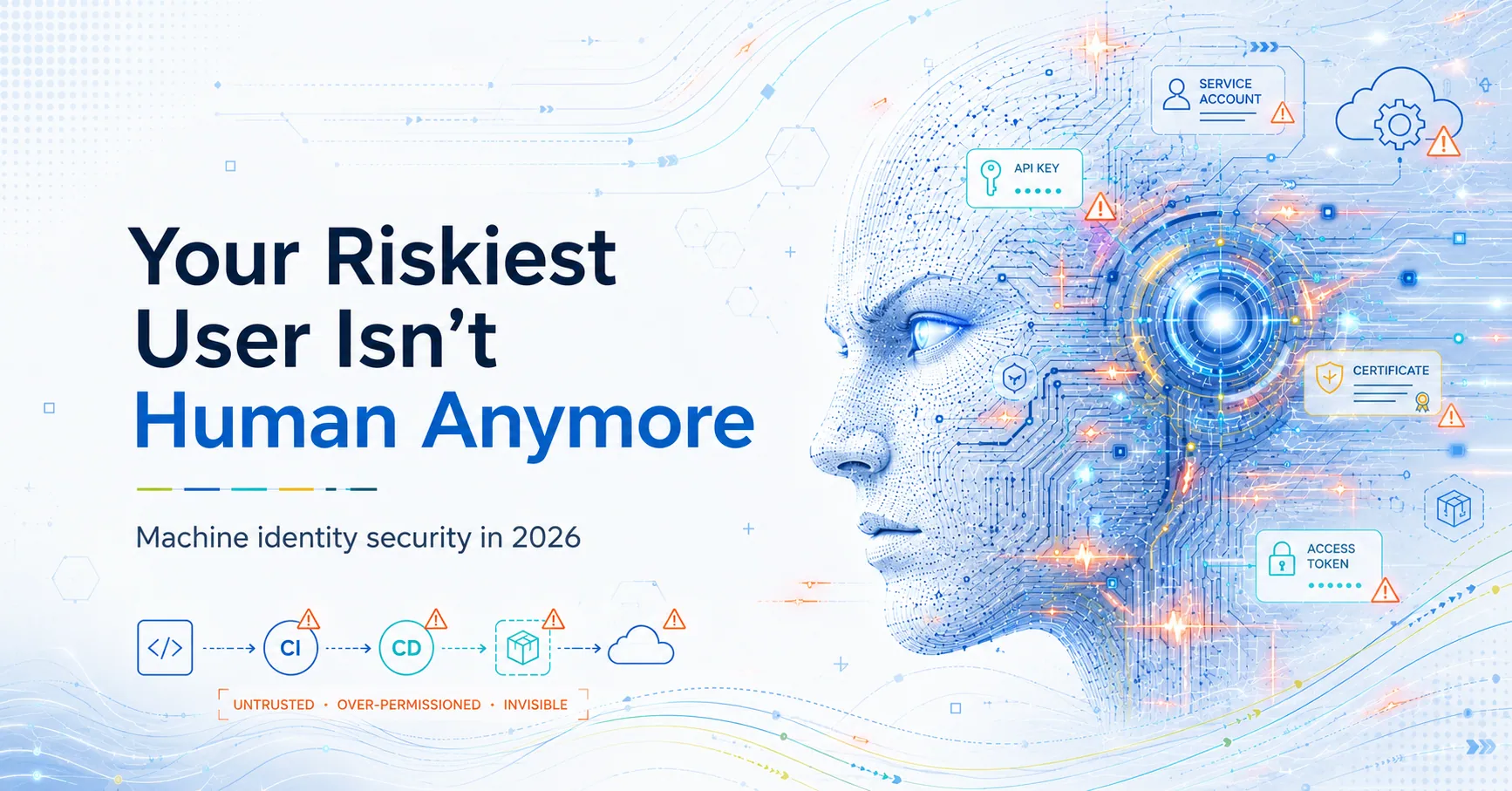
In 2026, the riskiest “user” in your environment might not be a person.
It might be a CI/CD pipeline.
Or a service account.
Or an API key.
Or a workload identity sitting inside Kubernetes with access to production systems, cloud storage, secrets, and customer data.
This is why machine identity security has moved from a niche technical issue to a core security priority. Most security teams already have a story for human privileged access. Admins get reviewed. Passwords go into vaults. Sessions get recorded. Privileged access management (PAM) projects are planned around people.
But modern enterprises no longer run only on people.
They run on automation.
Machine identities include APIs, service accounts, workloads, scripts, bots, schedulers, serverless functions, containers, CI/CD pipelines, AI agents, and integration users. These identities do not take lunch breaks. They do not resign. They do not always have owners. Many hold standing access for months or years.
That is the uncomfortable part.
Your strongest privileges may belong to identities no one thinks of as “users.”
Quick FAQs on Machine Identity Security
What is machine identity security?
Machine identity security is the practice of discovering, governing, securing, and monitoring identities used by systems, applications, workloads, bots, and pipelines. These identities often use API keys, tokens, certificates, service accounts, cloud roles, and workload identities to access systems and data.
Why are machine identities risky in CI/CD and cloud environments?
Machine identities are risky because they often hold persistent access to production, cloud resources, code repositories, deployment tools, and secrets. If a CI/CD token or cloud key is stolen, an attacker may be able to deploy malicious code, access data, or move across systems without using a human account.
How is machine identity security different from user identity security?
User identity security focuses on people, logins, MFA, sessions, and role reviews. Machine identity security focuses on automated access, service accounts and API keys, workload identities, secrets, certificates, and policy-based access between systems.
What is secrets sprawl and how does it affect machine identities?
Secrets sprawl happens when tokens, passwords, keys, and certificates are scattered across code repositories, config files, CI/CD variables, scripts, chat tools, and container images. Most of these secrets do not belong to humans. They belong to machine identities that connect systems together.
How can organisations start protecting non-human identities?
Start with inventory. Find service accounts, pipelines, API keys, bots, workloads, cloud roles, and long-lived tokens. Then assign ownership, reduce privileges, rotate secrets, remove stale identities, and bring high-risk machine identities into IAM and PAM review cycles.
Machine Identity Security Is Now a Privileged Access Problem
For years, privileged access programs focused on human admins.
That made sense.
The obvious risk was the domain admin, the database administrator, the cloud admin, or the contractor with production access.
But the access model has changed.
A CI/CD pipeline can push code to thousands of servers. A service account can read customer records. A cloud automation script can create infrastructure. A Kubernetes workload can pull secrets. An API key can connect internal systems, payment tools, analytics platforms, and customer-facing applications.
These are not low-risk technical objects.
They are privileged identities.
The problem is that many organisations still treat them like configuration details.
That mindset is outdated.
Machine identities now outnumber human identities in many enterprise environments. Industry reports place the ratio anywhere from dozens to one to far higher in cloud-heavy and AI-heavy environments. CyberArk’s 2025 reporting highlights an 82:1 machine-to-human identity ratio. Veza’s 2026 identity report points to non-human identities outnumbering human identities by 17:1.
The exact number will vary by environment.
The direction is clear.
Machine identities are growing faster than human identities. Many of them touch sensitive systems. Many are poorly governed. Many have more access than they need.
That makes machine identity security a board-level risk, not just a DevOps hygiene task.
Why Machine Identities Became the New Super Admins
A human admin usually has a job title, manager, HR record, login pattern, device, and review cycle.
A machine identity may have none of that.
It may exist because someone created it during a migration three years ago. It may have been added by a DevOps engineer to fix a deployment issue. It may sit inside a CI/CD tool with permissions copied from another project. It may belong to a vendor integration that no one has touched since go-live.
And still, it works.
That is the danger.
Machine identities often become “super admins” because teams want speed:
“Give the pipeline admin for now.”
“We’ll tighten it after release.”
“This token only runs internally.”
“This service account is required for the integration.”
“We cannot rotate that key because the app may break.”
These decisions sound practical in the moment. Over time, they create a hidden privilege layer.
This layer is hard to review because it is spread across cloud platforms, SaaS tools, repositories, CI/CD systems, Kubernetes clusters, secrets managers, scripts, and old documentation.
Attackers love that kind of mess.
Secrets Sprawl: How Pipelines Quietly Hold the Keys
Secrets sprawl is one of the clearest signs that machine identity security is weak.
Secrets include:
- API keys
- Access tokens
- Passwords
- SSH keys
- Certificates
- OAuth tokens
- Cloud access keys
- Database credentials
- Webhook secrets
- CI/CD variables
These secrets show up in places they should never live.
Code repositories. Build logs. Local config files. Docker images. Terraform files. CI/CD variables. Chat messages. Shared spreadsheets. Developer laptops. Old scripts. Test environments.
GitGuardian’s 2025 State of Secrets Sprawl report found 23.8 million secrets leaked on public GitHub repositories in 2024, a 25% year-over-year increase. The report also found that many older leaked secrets remain valid long after exposure.
That is not just a developer mistake.
It is a machine identity security failure.
Most leaked secrets are not for human login. They are for services, bots, pipelines, cloud workloads, integrations, and automation flows.
Here is a simple scenario.
A developer accidentally commits a CI/CD token to a public repository. The token has write access to the build pipeline and permission to push artifacts into production. An attacker finds the token, modifies a build step, and pushes a malicious package into the release process.
No phishing email.
No stolen employee laptop.
No brute force.
Just one exposed machine credential with too much power.
That is why CI/CD pipeline security cannot be separated from machine identity security.
Over-Privileged Non-Human Identities Are Everywhere
Most enterprises have more non-human identities than they can explain.
Some are active. Some are stale. Some are forgotten. Some are still powerful.
The biggest risks usually fall into four buckets.
1. Persistent Privileges
Many machine identities have standing access because teams do not want automation to fail.
That is understandable.
But standing access is standing risk.
A pipeline that needs production access during deployment does not need permanent admin rights every hour of the day. A service account that reads one storage bucket should not have broad access across the cloud account.
Machine identities need least privilege just like humans do.
2. No Clear Owner
A human account has an owner.
A machine identity often does not.
Who owns the deployment token? The DevOps team? The app team? The platform team? The security team? The engineer who created it but left last year?
No owner means no one rotates it, reviews it, or removes it.
3. Weak Lifecycle Management
Human accounts usually connect to joiner, mover, and leaver processes.
Machine identities often bypass that discipline.
A service account may be created during a project and remain active after the project ends. A token may be issued for a migration and still work two years later. A test integration may be abandoned but still have access to production data.
These are zombie identities.
They are not always visible. They are not always monitored. But attackers can still use them.
4. Excluded from PAM Reviews
Many privileged access management (PAM) programs still define privileged users as people.
That leaves pipelines, bots, service accounts, and API keys outside access reviews.
This is a serious gap.
If a non-human identity can access production, customer data, cloud admin APIs, deployment systems, or secrets, it belongs in the privileged access conversation.
Why Traditional PAM Misses the Machine Identity Problem
Traditional PAM was built for human workflows.
A person logs in. The person checks out a password. The person uses a jump server. The session gets recorded. The password gets rotated.
That model still matters.
But machine identities do not always work that way.
They authenticate through API keys, OAuth tokens, cloud roles, workload identities, certificates, service principals, and short-lived tokens. They run inside pipelines, containers, functions, schedulers, bots, and background jobs. They may trigger hundreds of actions without any interactive login.
They do not sit neatly behind a jump box.
That creates a design gap.
PAM for humans only is now a partial solution.
A modern privileged access strategy must cover:
- Human admins
- Service accounts
- API keys
- CI/CD pipelines
- Cloud roles
- Kubernetes workloads
- Automation scripts
- AI agents
- SaaS integration accounts
- Certificates and tokens
The governance gap is just as big.
DevOps creates some identities. Platform teams create others. App teams create service accounts. Security owns policies. IAM owns directories. Cloud teams own roles. Vendors add integrations.
Everyone touches the machine identity lifecycle.
No one owns the whole thing.
That must change.
Risk Scenario 1: A Compromised Pipeline Pushes Malicious Builds
A CI/CD pipeline has access to source code, build systems, deployment environments, artifact registries, and production infrastructure.
That makes it a high-value identity.
If an attacker compromises a pipeline token, they may not need to compromise servers one by one. They can attack the software delivery process itself.
The impact can include:
- Malicious builds pushed to production
- Backdoored packages
- Stolen secrets from build environments
- Supply-chain compromise
- Ransomware staging
- Regulatory exposure
- Customer trust damage
This is why CI/CD pipeline security must include secret scanning, least privilege, signed builds, workload identity, short-lived credentials, and strict approval paths for production deployment.
Your pipeline is not just a tool.
It is a privileged actor.
Risk Scenario 2: A Forgotten Cloud Key Still Has Broad Access
A script was created during a cloud migration.
It needed admin access at the time.
The migration ended. The script was forgotten. The access key remained valid.
Sixteen months later, that key appears in an old config file copied to a shared location. An attacker finds it and uses it to list storage buckets, create new users, and access sensitive data.
This happens because service accounts and API keys often outlive their business purpose.
Cloud identity security must answer hard questions:
- Which machine identities can reach production?
- Which keys are still active?
- Which identities have not been used in months?
- Which identities can create new credentials?
- Which identities have wildcard permissions?
- Which identities have access to customer data?
If the team cannot answer these questions, cloud identity risk is already higher than it looks.
Risk Scenario 3: An AI Agent Gets Access No One Tracks
AI assistants and agents are becoming a new class of machine identity.
They can read documents, query systems, call APIs, update tickets, trigger workflows, and sometimes act across multiple enterprise tools.
That creates new risk.
An AI assistant may have access to internal knowledge, customer records, code repositories, security tickets, CRM data, or operational systems. If it is not tracked in IAM, not included in recertification, and not governed by clear policies, it becomes invisible privilege.
The risk is not only that the agent makes a mistake.
The risk is that no one knows what the agent can do.
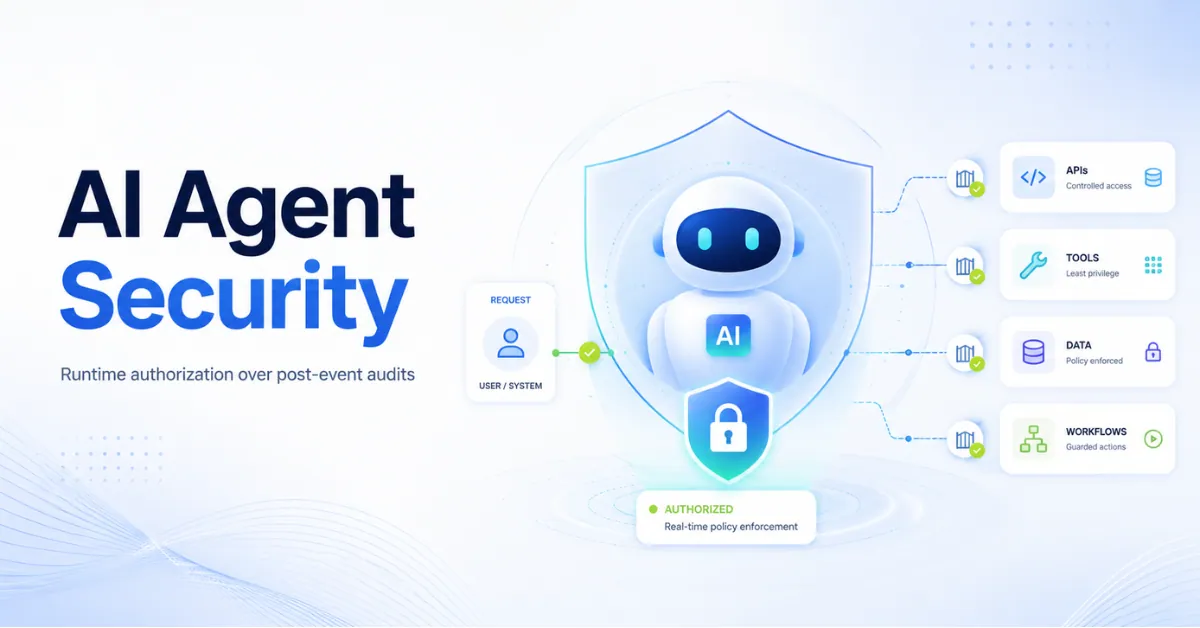
Machine identity security must now include agent identities, tool permissions, API scopes, data access, and action limits.
AI does not remove the identity problem.
It expands it.
What Good Machine Identity Security Looks Like
Strong machine identity security is practical. It does not ask teams to stop automating. It asks them to govern automation like real access.
1. Inventory and Classification
Start by finding machine identities across:
- Cloud platforms
- CI/CD tools
- Kubernetes
- SaaS applications
- Repositories
- Secrets managers
- API gateways
- Service meshes
- Serverless platforms
- Databases
- Automation scripts
Classify them by risk.
A read-only test bot is not the same as a production deployment pipeline. A service account with access to customer data is not the same as a logging integration.
Treat machine identities as first-class citizens in IAM.
2. Least Privilege for Non-Human Identities
Apply least privilege to non-human identities with the same discipline used for human access.
Use role-based access control where roles are stable.
Use attribute-based access control where context matters.
Limit access by:
- Resource
- Environment
- Action
- Time
- Network path
- Workload identity
- Deployment stage
- Business purpose
Do not give a pipeline admin rights because it is easier.
That shortcut becomes risk.
3. Centralised Secrets Management
Hard-coded secrets should not exist in code, images, scripts, or shared documents.
Use vaults and secrets managers integrated with:
- CI/CD systems
- Kubernetes
- Cloud workloads
- Serverless functions
- Applications
- Infrastructure as code
- Developer workflows
Move toward short-lived credentials where possible.
Static secrets are easier to leak, harder to rotate, and more dangerous when forgotten.
4. Lifecycle Management
Every machine identity needs a lifecycle.
That lifecycle should include:
- Business justification
- Owner assignment
- Approval
- Least privilege design
- Rotation schedule
- Usage monitoring
- Recertification
- Retirement
If no one owns an identity, it should not have sensitive access.
5. Monitoring and Anomaly Detection
Machine identities have patterns.
A deployment pipeline usually runs from known locations. A service account usually accesses known resources. A workload usually talks to specific systems.
Monitor for behavior that breaks the pattern:
- New regions
- New services
- Unusual data access
- Privilege escalation
- New credential creation
- First-time access to production
- Access outside normal deployment windows
- Sudden spikes in API calls
Security teams should not only ask whether a machine identity is valid.
They should ask whether its behavior makes sense.
Actionable Checklist for CISOs and Identity Leads
Use this checklist to test your current machine identity security posture.
- Can we list all machine identities across cloud, CI/CD, Kubernetes, SaaS, and internal systems?
- Which pipelines can deploy to production today?
- Which service accounts can access customer data?
- Where do we still have hard-coded secrets?
- Which API keys are long-lived and unrotated?
- Which non-human identities have admin or wildcard permissions?
- Who owns each high-risk machine identity?
- Are machine identities included in privileged access management (PAM) reviews?
- Are unused service accounts and stale tokens removed?
- Do we monitor machine identity behavior for unusual activity?
- Do AI agents and assistants have defined owners, scopes, and access limits?
- What is our 12-month roadmap for machine identity security?
This is not a paperwork exercise.
These questions expose real attack paths.
Conclusion: Machine Identity Security Is Now Core to Privileged Access Risk
Machine identity security is no longer optional.
The modern enterprise runs on automation, pipelines, cloud workloads, service accounts, bots, APIs, and AI agents. Many of these identities hold persistent access. Some can deploy code. Some can read customer data. Some can create infrastructure. Some can reach secrets.
That is privileged access.
Security teams cannot protect only human admins and call the job done.
The next phase of privileged access management must cover humans, machines, and agents together. That means inventory, ownership, least privilege, centralized secrets management, lifecycle control, and behavior monitoring.
In 2026, your riskiest “user” might not be a person. It might be a pipeline.
The only real question is whether your security strategy has caught up.
FAQ
1. What is machine identity security?
Machine identity security is the practice of protecting identities used by systems, applications, workloads, bots, APIs, and CI/CD pipelines. These identities often use tokens, certificates, cloud roles, service accounts and API keys to access systems. Unlike human users, machine identities usually run in the background without direct supervision. That makes discovery, ownership, least privilege, rotation, and monitoring essential.
2. Why is machine identity security important in 2026?
Machine identity security is important because enterprises now run on automation, cloud services, APIs, pipelines, and AI agents. These non-human identities often outnumber human users and can hold powerful access to production, customer data, and cloud resources. If one machine identity is compromised, attackers may move quickly across systems. The risk is no longer only about employees with admin access.
3. What are machine identities?
Machine identities are digital identities used by non-human systems to authenticate and access resources. Examples include service accounts, API keys, bots, workloads, containers, scripts, schedulers, certificates, and CI/CD pipelines. They help systems talk to each other without human login. The problem starts when these identities get broad privileges and no clear owner.
4. How are non-human identities different from human identities?
Human identities belong to employees, contractors, admins, and partners who log in through user accounts. Non-human identities belong to applications, services, workloads, pipelines, bots, and automation tools. They usually authenticate through API keys, tokens, certificates, or cloud roles. This makes them harder to govern through traditional IAM and privileged access management (PAM) processes.
5. Why are CI/CD pipelines risky machine identities?
CI/CD pipelines are risky because they can build, test, deploy, and change production systems. If CI/CD pipeline security is weak, a stolen token or exposed secret can let attackers inject malicious code into the release process. A compromised pipeline can affect thousands of servers or users at once. That is why pipelines should be treated as privileged machine identities, not just DevOps tools.
6. What is secrets sprawl?
Secrets sprawl happens when passwords, API keys, tokens, certificates, and credentials are scattered across code repositories, config files, CI/CD variables, scripts, chat tools, and container images. Many of these secrets belong to machine identities, not human users. Once secrets spread, they become hard to rotate, monitor, and remove. This directly weakens machine identity security.
7. How do service accounts and API keys create security risk?
Service accounts and API keys create risk when they are over-privileged, long-lived, poorly documented, or forgotten after a project ends. Many teams create them for integrations, migrations, testing, or automation and never remove them. If attackers steal one valid key, they may gain access without triggering normal user-based controls. Every high-risk service account should have an owner, purpose, scope, and expiry plan.
8. How does privileged access management help machine identity security?
Privileged access management (PAM) helps by bringing high-risk machine identities into access reviews, policy controls, approval workflows, and monitoring. Traditional PAM focused mainly on human admins, but modern PAM must also cover service accounts, CI/CD pipelines, cloud roles, and automation identities. If a machine identity can access production or sensitive data, it should be treated as privileged. PAM for humans only is no longer enough.
9. What role does cloud identity security play in machine identity risk?
Cloud identity security is critical because cloud environments depend heavily on roles, tokens, service principals, workloads, and automation accounts. A single over-privileged cloud identity can create users, access storage, change infrastructure, or expose data. Machine identities in AWS, Azure, GCP, Kubernetes, and SaaS tools need least privilege and continuous review. Cloud access should be temporary, scoped, and monitored wherever possible.
10. How can organisations start protecting machine identities?
Start by building an inventory of machine identities across cloud, CI/CD, Kubernetes, SaaS, APIs, and internal systems. Then identify which non-human identities can access production, secrets, customer data, or privileged systems. Remove stale accounts, rotate exposed credentials, reduce permissions, and assign clear owners. After that, bring high-risk machine identities into IAM, PAM, secrets management, and monitoring programs.