
Across enterprise deployments, 72 percent of RAG failures trace back to mismatched or incomplete RAG pipeline components. Teams often select advanced models yet overlook ingestion, indexing, or retrieval tuning. When outputs degrade, leaders blame the language model. In reality, the failure usually originates in upstream architecture decisions.
Retrieval augmented generation combines document retrieval with large language model reasoning. Instead of relying solely on pre training, the model retrieves relevant internal knowledge at query time. This approach reduces hallucinations and aligns responses with enterprise data. However, it works only when each layer of the retrieval augmented generation pipeline performs reliably.
Executives evaluating enterprise RAG architecture need clarity on sequencing and integration. A strong system does not begin with model selection. It begins with structured ingestion and disciplined data handling. From there, embedding, indexing, retrieval, prompting, and post processing operate as a coordinated system.
This guide provides a complete breakdown of RAG pipeline components, a simplified RAG system diagram explanation, and a practical implementation order. Production systems demand architectural discipline. The sections below outline what matters and where enterprises typically go wrong.
Enterprises typically align these controls with a broader enterprise RAG governance frameworkto ensure traceability, access discipline, and regulatory alignment.
1. Data Ingestion Layer
The ingestion layer forms the base of all RAG pipeline components. It connects source systems to the retrieval infrastructure. Enterprises typically ingest content from document management platforms, intranets, ticketing systems, shared drives, and structured databases.
Reliable connectors matter. If synchronization fails or permissions misalign, the entire enterprise RAG architecture weakens. Our clients find that access control mapping must occur before indexing begins. Without role aware ingestion, downstream retrieval risks exposing restricted content.
Preprocessing is equally critical. Text extraction, normalization, and cleaning shape the quality of embeddings later. Many enterprises rely heavily on PDF archives. In practice, PDF parsing can drop up to 30 percent of contextual information, especially in tables and footnotes. When content disappears at ingestion, retrieval accuracy declines.
Deduplication and version control should also occur here. Production systems demand authoritative sources. Draft policies and obsolete manuals should not coexist with final versions. Enterprises report confusion when retrieval surfaces outdated documentation.
The ingestion layer also defines update cadence. Some repositories change daily. Others refresh quarterly. A stable ingestion process includes automated pipelines, error logging, and monitoring alerts. If ingestion breaks silently, the entire retrieval augmented generation pipeline becomes stale.
In summary, ingestion determines what the system knows. If the intake is flawed, no downstream optimization will compensate.
2. Chunking and Segmentation
Once data enters the system, segmentation shapes how it will be retrieved. Chunking divides documents into smaller, searchable units. This step often determines retrieval quality more than model selection.
There are two dominant strategies. Fixed size chunking splits text by character or token length. Semantic chunking respects logical boundaries such as sections, headings, or paragraphs. Enterprises report better precision when semantic boundaries guide segmentation.
Enterprise documents present unique challenges. Contracts contain clauses tied to appendices. Technical manuals include tables that should remain intact. Breaking content mid table can distort meaning. Production systems demand chunking rules that account for headers, footers, and structured layouts.
Overlap strategies help preserve context. Small overlaps between adjacent chunks ensure continuity during retrieval. Without overlap, key phrases may separate from supporting explanations. However, excessive overlap inflates storage and retrieval costs.
Our clients find that chunk sizes between 300 and 800 tokens balance context depth with precision. The correct size depends on document type and typical query complexity. Testing remains essential.
Chunking is not merely technical formatting. It defines how knowledge fragments align with user questions. Within the retrieval augmented generation pipeline, segmentation creates the building blocks for embedding and indexing. Errors here cascade through every subsequent layer.
3. Embedding Generation
Embeddings translate text into numerical vectors. These vectors allow semantic similarity search. In modern enterprise RAG architecture, embedding quality strongly influences retrieval relevance.
Leading 2026 models such as text-embedding-4 and bge-large offer improved multilingual and domain performance. However, higher dimensional vectors increase storage requirements and computation costs. Enterprises must balance precision against scalability.
Dimension tradeoffs require testing. Higher dimensions can capture nuance but may slow retrieval at scale. Production systems demand benchmarking across realistic query volumes.
Batch processing improves efficiency. Instead of embedding documents individually, enterprises process large batches during ingestion cycles. This reduces latency and improves resource utilization.
Clean input text remains critical. Boilerplate headers, repetitive disclaimers, and navigation artifacts distort embeddings. Our clients observe measurable retrieval gains after removing redundant formatting.
Embedding generation connects raw content to the vector database. When done correctly, it transforms static documents into searchable knowledge assets.
4. Vector Database and Indexing
The vector database stores and retrieves embeddings efficiently. It forms the backbone of the retrieval augmented generation pipeline. Selection and configuration directly affect performance and cost.
Platforms such as Pinecone and Weaviate offer managed scalability and operational simplicity. Pinecone provides streamlined infrastructure with minimal maintenance. Weaviate supports hybrid search and schema flexibility. Enterprises evaluate based on workload, compliance needs, and integration complexity.
Indexing strategy also matters. HNSW indexing supports fast approximate nearest neighbor search with strong recall. IVF indexing can improve performance for very large datasets but may require careful tuning. Production systems demand tradeoff analysis between speed, memory usage, and recall rates.
Multi tenancy introduces additional design decisions. Enterprises often partition indexes by department, geography, or client. Logical partitioning improves access control and retrieval relevance. Without isolation, cross tenant contamination can occur.
Capacity planning remains essential. As document volumes grow, vector databases must scale horizontally. Enterprises report unexpected cost spikes when indexing expands without monitoring.
The vector database transforms embeddings into retrievable knowledge. Misconfiguration here can undermine even well designed ingestion and chunking processes. Among all RAG pipeline components, indexing errors are some of the most expensive to fix later.
5. Retrieval Mechanism
Retrieval determines which chunks feed the language model. The mechanism must balance precision, recall, and latency. Enterprises often adopt hybrid search to improve robustness.
Hybrid search combines dense vector similarity with sparse keyword search. This approach captures both semantic nuance and exact phrase matching. Production systems demand this balance, especially in regulated industries.
Reranking adds another refinement layer. Cross encoders or T5 based rerankers rescore candidate results based on query relevance. This improves answer accuracy but increases latency. Enterprises test reranking only after baseline retrieval stabilizes.
Top K optimization matters. Retrieving too few documents risks missing context. Retrieving too many inflates token usage and cost. Our clients find that five to ten high quality chunks often suffice for most enterprise queries.
Maximal Marginal Relevance techniques enhance diversity. They reduce redundant chunks and broaden contextual coverage. Retrieval tuning requires ongoing evaluation, not one time configuration.
6. Prompt Augmentation and LLM
After retrieval, the system injects selected context into the model prompt. Context injection patterns influence coherence and faithfulness.
Structured prompts clarify roles and instructions. They separate user query, retrieved context, and response expectations. Production systems demand explicit grounding instructions to minimize hallucination risk.
Token limits constrain context size. Enterprises must monitor prompt length to avoid truncation. Efficient retrieval reduces unnecessary context injection.
Guardrails define acceptable outputs. Enterprises implement content filters, policy constraints, and refusal logic. Within the enterprise RAG architecture, prompting bridges retrieval and reasoning.
7. Post Processing and Ranking
Post processing validates and refines model output. It forms the final safeguard among RAG pipeline components.
Faithfulness checks compare responses against retrieved sources. Some systems calculate similarity between answer sentences and supporting chunks. This reduces unsupported claims.
Answer synthesis may restructure content into executive summaries or structured formats. Enterprises report higher adoption when outputs match business communication styles.
Caching improves performance for repeated queries. Frequently asked questions should not trigger full retrieval cycles each time. Production systems demand efficiency at scale.
Post processing transforms raw model output into enterprise ready responses.
Visual RAG Pipeline Diagram
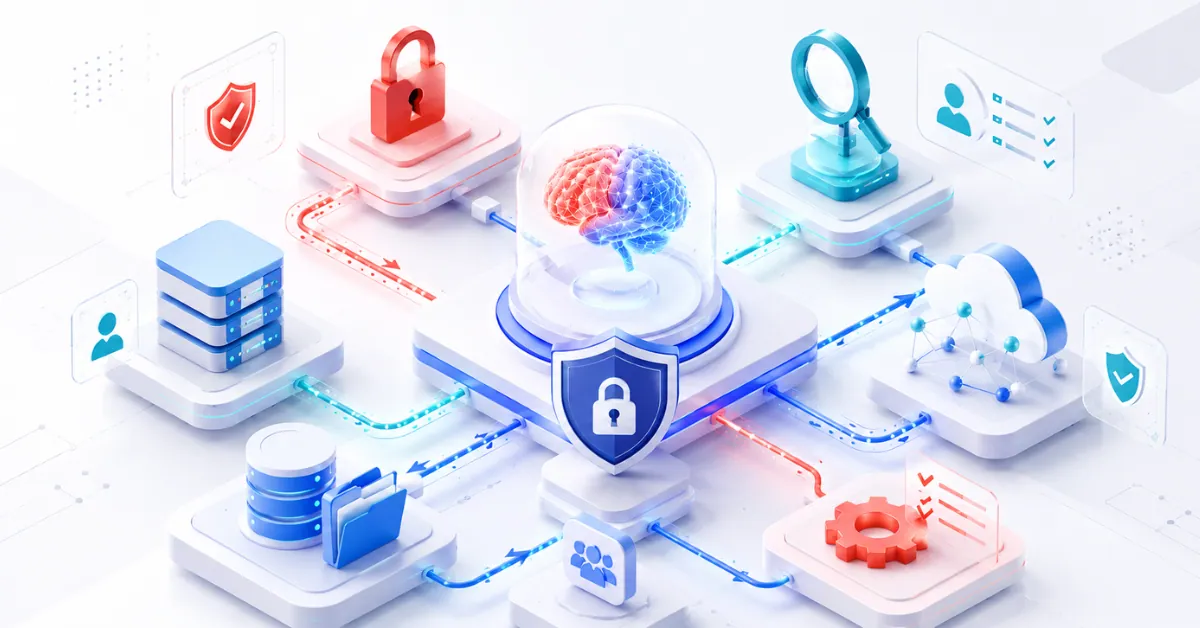
The RAG system diagram for enterprise use typically shows eight sequential components. Data sources feed ingestion. Ingestion connects to preprocessing. Preprocessing flows into chunking. Chunking feeds embedding generation. Embeddings enter the vector database. Retrieval selects top matches. Prompts combine context with queries. Post processing validates final responses.
Conclusion
Strong RAG pipeline components create reliable enterprise knowledge systems. Failures rarely stem from the language model alone. They arise from weak ingestion, flawed segmentation, or poorly tuned retrieval.
Enterprises report the most success when implementation follows a disciplined order. Start with ingestion audit. Validate chunking. Benchmark embeddings. Configure indexing carefully. Only then optimize retrieval and prompting.
Organizations that prefer an integrated solution often evaluate a production-ready Enterprise Knowledge Assistant platform that already incorporates these RAG pipeline components within a governed architecture.
For deeper architectural guidance, review our framework at /resources/guides/rag-systems-trustworthy-ai-guide or explore deployment options through /products/eka. Structured foundations drive sustainable outcomes.
FAQ
What order should enterprises build RAG components?
Begin with ingestion and preprocessing. Follow with chunking and embedding generation. Configure the vector database next. Only after stable retrieval should teams optimize prompting and post processing layers.
What is the cost of a vector database at scale?
Costs vary by document volume and query frequency. Enterprises report monthly expenses ranging from thousands to tens of thousands of dollars depending on storage size and retrieval traffic.
How long does it take to implement a retrieval augmented generation pipeline?
Production deployments typically require eight to sixteen weeks. Timeline depends on data readiness, integration complexity, and governance approvals.
Do all enterprises need hybrid search?
Not always. Hybrid search benefits environments with complex terminology or regulatory language. Simpler datasets may perform adequately with dense search alone.
How many documents can a vector database handle?
Modern systems scale to millions of vectors. Proper indexing and partitioning ensure performance remains stable under heavy workloads.
Is chunk size the same across industries?
No. Legal documents often require smaller chunks. Technical manuals may allow larger segments. Testing against real queries determines optimal sizing.
How do enterprises measure retrieval quality?
They evaluate precision, recall, latency, and answer faithfulness. Offline testing with labeled queries provides reliable performance benchmarks.
Can RAG systems operate in regulated industries?
Yes. Enterprises implement strict access controls, logging, and compliance checks. Proper governance ensures alignment with regulatory requirements.