Secure enterprise AI assistants are no longer judged by how well they answer simple policy questions. They are judged by whether they can retrieve the right data, respect permissions, explain their sources, and support high-value business decisions without creating security or compliance risk.
That is where many internal AI assistants break.
Your engineering team may spend six months building a polished AI knowledge assistant. It may have a clean interface, a vector database, connectors to SharePoint and Confluence, and a confident demo script.
Then a senior user asks:
“Compare our Q3 contract liabilities with Q2 and flag any new indemnification risks.”
The assistant does one of three things.
- It summarizes one document and misses the real answer.
- It lists multiple PDFs and forces the user to read everything manually.
- It gives a confident answer based on mismatched or outdated content.
The result is predictable. Employees lose trust. Teams return to keyword search. Leaders start asking why the AI investment did not deliver business value.
This is not only a model problem. It is an architecture problem. Most failed enterprise assistants are built on naive RAG, a retrieval pattern that works for simple demos but struggles in complex, regulated, multi-source environments.
To build secure enterprise AI assistants that people can trust, organizations need to move toward Agentic RAG.
For teams planning an internal AI knowledge layer, Zenxsys’ Enterprise Knowledge Assistant shows how enterprise search, RAG, and governed access can work together for secure knowledge retrieval.
What Is Naive RAG?
Naive RAG is the basic form of Retrieval-Augmented Generation.
The flow is simple:
User Query → Vector Search → Top-K Chunks → LLM Answer
The system takes the user’s question, searches a vector database, retrieves the most similar text chunks, and passes them to a large language model to generate an answer.
This approach works well when the question is simple and the answer lives in one clean document.
For example:
“What is our leave policy?”
or
“Summarize this onboarding document.”
But enterprise questions are rarely that clean. Business users ask questions that cross systems, teams, documents, time periods, and access levels.
Naive RAG assumes that the right answer already exists in one nearby chunk. That assumption breaks quickly inside enterprise data environments.
Why Naive RAG Fails in Enterprise Workloads
1. It Cannot Handle Multi-Step Reasoning
Many enterprise AI projects fail because they treat retrieval as a simple search problem. For a deeper view of rollout issues, read common mistakes when deploying AI knowledge assistants .
Naive RAG is usually a one-shot retrieval process. It searches once, fetches chunks, and generates an answer.
That is a problem when the user’s question needs multiple steps.
For example:
“Compare our current vendor risk policy with last year’s contract exceptions and identify gaps for new SaaS vendors.”
This question may require:
- Policy documents
- Contract records
- Vendor risk reports
- Exception approvals
- Audit notes
A simple vector search cannot plan this workflow. It cannot decide which system to search first, which evidence to compare, and which missing context to ask for.
This is why many AI knowledge assistants perform well in demos but fail when real business users ask layered questions.
2. It Retrieves Similar Text, Not Always the Right Evidence
Vector search is powerful, but semantic similarity is not the same as business relevance.
A naive RAG system may retrieve paragraphs that sound similar to the user’s question but do not contain the exact answer. This is common in large enterprises where policy templates, legal documents, and compliance reports repeat the same language across many files.
The assistant may fetch the wrong version of a policy, a duplicated document, or an outdated approval note.
That creates a serious issue for secure enterprise AI assistants. If the system cannot distinguish between “similar” and “authoritative,” users may act on weak evidence.
3. It Has No Built-In Self-Correction
In a naive RAG pipeline, the system often trusts the first retrieved context.
If the retrieved chunks are poor, the language model still tries to answer. That is where RAG hallucination risk increases.
The model may produce a confident answer from incomplete evidence. It may combine unrelated snippets. It may answer a compliance or contract question without enough support.
For enterprise AI systems, this is not acceptable. NIST’s AI Risk Management Framework places strong focus on trustworthy AI practices such as validity, reliability, safety, security, resilience, accountability, and transparency. Those expectations become even more important when AI systems support business decisions or sensitive workflows.
Why Naive RAG Becomes a Security and Compliance Problem
Naive RAG is often discussed as an accuracy issue. In enterprise environments, it can also become a security and governance issue.
OWASP lists security risks for LLM applications, including prompt injection and sensitive information disclosure, which are directly relevant when AI systems retrieve enterprise data and respond to users.
Three risks matter most.
Sensitive Data Exposure
This is where secure access design becomes critical. Enterprises handling privileged access should also review intent-aware PAM and zero standing privileges as part of their broader security architecture.
If access control is not enforced during retrieval, a user may receive information from documents they should not be allowed to see.
This can happen when the vector database stores mixed-access documents without strong permission filtering at query time.
For secure RAG systems, permission checks must happen before retrieval, during retrieval, and before answer generation.
Unsupported Compliance Answers
A naive RAG system may answer policy, audit, or legal questions without showing which document supports each claim.
That creates risk for compliance, legal, finance, and cybersecurity teams.
A useful enterprise AI assistant should not only answer. It should show the source, document version, date, and confidence level where needed.
Weak Auditability
If an AI assistant cannot show how it reached an answer, teams cannot review or defend the output later.
That matters when the answer affects:
- Vendor risk decisions
- Access approvals
- Incident response
- Customer commitments
- Contract review
- Security exceptions
- Regulatory reporting
Secure enterprise AI assistants need traceability by design. The answer path must be logged, reviewable, and tied back to source evidence.
What Is Agentic RAG?
Agentic RAG adds planning, routing, tool use, evaluation, and feedback loops to the retrieval process.
Instead of treating retrieval as a one-step database lookup, Agentic RAG uses agents to manage the task.
An agent can:
- Understand the user’s intent
- Break the question into smaller tasks
- Choose the right data source
- Run multiple retrieval steps
- Check answer quality
- Reject weak evidence
- Ask for clarification
- Cite sources
- Log the answer path
This is a major shift in enterprise AI architecture.
If your team is comparing deployment models, this guide on local LLMs vs cloud LLMs can help clarify the trade-offs around control, cost, latency, and data security.
Frameworks such as LangGraph support stateful, multi-step agent workflows, while LlamaIndex supports agent and workflow patterns for building applications over enterprise data. These frameworks are not magic fixes, but they give engineering teams better building blocks for complex retrieval and reasoning workflows.
Naive RAG vs Agentic RAG
| Architecture Area | Naive RAG | Agentic RAG |
|---|---|---|
| Execution | One-shot retrieval | Iterative planning loop |
| Query handling | Searches the original query | Rewrites and decomposes the query |
| Data sources | Usually one vector database | Vector DB, SQL, APIs, graph, documents |
| Reasoning | Limited multi-step logic | Handles multi-step workflows |
| Security | Often added later | Designed into routing and retrieval |
| Access control | Can be weak if not engineered well | Permission-aware retrieval patterns |
| Evaluation | Trusts retrieved chunks | Checks relevance and groundedness |
| Auditability | Limited answer trace | Logged, cited, reviewable answer path |
| Best use case | Simple Q&A | Complex enterprise knowledge work |
The Three Pillars of Agentic RAG Architecture
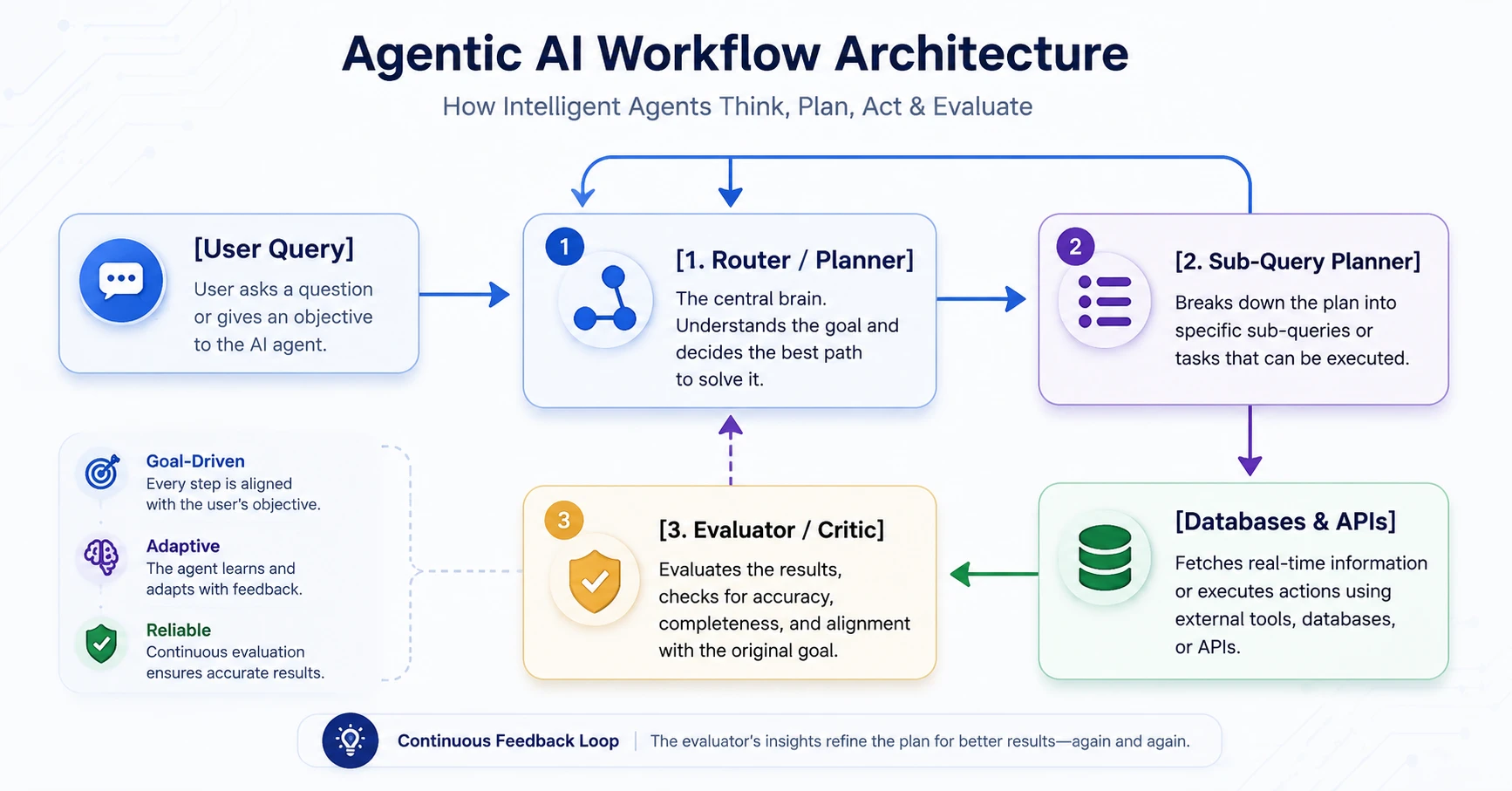
Agentic RAG works because it does not treat every enterprise question like a simple search query. It plans, routes, breaks down, checks, and improves the answer before showing it to the user.
Intelligent Routing
A secure enterprise AI assistant should not search every source the same way.
A sales number may belong in a structured database. A policy question may belong in a document index. A relationship question may need a knowledge graph. A security workflow may need an API call.
- “Show last month’s revenue variance by region.”
- “What changed in our remote access policy?”
- “Which vendors have access to customer data and open security exceptions?”
The router agent decides where to go based on intent. That routing layer is a core part of Agentic RAG.
Sub-Query Decomposition
Complex questions need to be broken down before the system can answer them well.
- Retrieve European performance reports
- Retrieve APAC operating guidelines
- Compare the two datasets
- Identify gaps
- Generate a cited answer
This makes the assistant more useful for real business questions and reduces hallucination risk.
Evaluator-Critic Loop
The evaluator or critic checks whether the answer is good enough before it reaches the user.
- Did the retrieved sources answer the question?
- Are there conflicting documents?
- Is the answer grounded in evidence?
- Are citations present?
- Is the user allowed to see this data?
- Does the system need another search?
If the answer is weak, the system can retry retrieval, reformulate the query, ask for clarification, or return a safer response.
This loop is critical for RAG security, accuracy, and trust.
How to Build Secure Enterprise AI Assistants
Start With Data Hygiene
Bad documents create bad AI answers.
Before moving to Agentic RAG, clean the knowledge base:
- Remove duplicate files
- Archive outdated policies
- Add document owners
- Add document dates
- Tag access levels
- Identify source-of-truth repositories
- Separate public, internal, confidential, and restricted data
This is where many projects fail. Teams want a better model, but the real issue is weak enterprise content governance.
Design Permission-Aware Retrieval
For secure access to enterprise systems and applications, Zenxsys also provides Managed Apache Guacamole Access Services , helping teams strengthen remote access governance and control.
Do not treat the vector database as a neutral storage layer.
For secure enterprise AI assistants, retrieval must respect user roles, groups, business units, and document permissions.
A good architecture should answer:
- Who is asking?
- What are they allowed to access?
- Which source is authoritative?
- Can this answer be shown?
- Should sensitive parts be masked?
- Should the answer be logged?
This is especially important for cybersecurity, HR, legal, finance, healthcare, and customer data workflows.
Use Hybrid Storage
Teams that want to build trustworthy AI systems should also explore this guide on RAG systems for trustworthy AI to understand how retrieval quality, grounding, and governance shape reliable AI outcomes.
Do not push every type of knowledge into one vector database.
Use the right store for the right task:
- Vector search for unstructured documents
- SQL for exact numbers and records
- Knowledge graphs for relationships
- APIs for live system data
- Document stores for versioned content
This improves retrieval quality and reduces the risk of wrong answers.
Add Human Review for High-Risk Use Cases
Not every workflow should be fully autonomous.
For low-risk knowledge search, the AI assistant can answer directly with citations.
For high-risk decisions, such as access approval, regulatory interpretation, or incident response, use human-in-the-loop review.
This gives business teams speed without removing control.
When Should Enterprises Move From Naive RAG to Agentic RAG?
Naive RAG can still work for simple document search. But when your AI assistant starts supporting business decisions, security reviews, compliance workflows, or multi-system queries, the architecture needs to mature.
You should consider Agentic RAG when your AI assistant:
- Fails on complex questions
- Retrieves outdated or irrelevant documents
- Cannot cite answers clearly
- Answers from sources users should not access
- Cannot handle structured and unstructured data together
- Needs multi-step reasoning
- Supports legal, finance, security, or compliance teams
Simple rule
If the assistant only answers simple policy questions, Naive RAG may be enough.
If it supports enterprise decisions, security, compliance, or cross-system workflows, Agentic RAG becomes a serious architecture choice.
Naive RAG is still useful for simple use cases. It can work for document summarization, basic policy Q&A, and narrow knowledge bases. But when the assistant supports high-impact workflows, naive RAG becomes too limited.
Audit Your RAG Architecture Before Scaling
If your internal AI assistant is hallucinating, missing context, or struggling with permissions, the problem may not be the model.
It may be your retrieval architecture.
Zenxsys can help you review your RAG pipeline, data hygiene, access-control model, citation quality, and
hallucination risk before your AI assistant reaches production scale.
Conclusion
Secure enterprise AI assistants need more than a vector database and a chatbot interface.
They need accurate retrieval, strong access control, source citations, self-correction, and auditability. Naive RAG helped teams build fast prototypes, but it often fails when real enterprise users ask complex, high-impact questions.
Agentic RAG gives enterprises a stronger path. It adds planning, routing, evaluation, and governance to the retrieval process.
For leaders building AI knowledge assistants, the goal is not just to answer questions faster. The goal is to create a trusted system that can support better decisions without increasing data, security, or compliance risk.
That is why secure enterprise AI assistants need Agentic RAG.
FAQs
What is Agentic RAG?
Agentic RAG is a retrieval architecture where AI agents plan, route, retrieve, evaluate, and refine answers instead of running a single search. It helps enterprise AI assistants handle complex questions, multiple data sources, and source-backed responses.
Why does naive RAG fail in secure enterprise AI assistants?
Naive RAG often fails because it performs one retrieval step and trusts the first set of chunks. In secure enterprise AI assistants, this can lead to weak answers, missing context, poor citations, and access-control risks.
How does Agentic RAG reduce hallucination risk?
Agentic RAG reduces hallucination risk by checking retrieved evidence before generating a final answer. Evaluator or critic agents can reject weak context, trigger another search, or ask for clarification when the system lacks enough evidence.
What should enterprises check before building Agentic RAG?
Enterprises should check data hygiene, document ownership, access permissions, source-of-truth systems, retrieval quality, logging needs, and risk level. Strong AI data governance should come before scaling any enterprise RAG system.
Is Agentic RAG always better than naive RAG?
Naive RAG can work for simple document Q&A and narrow knowledge bases. Agentic RAG is better when the use case needs multi-step reasoning, hybrid data access, permission-aware retrieval, and auditable answers.
What should buyers look for in a secure RAG system?
Buyers should look for permission-aware retrieval, cited answers, audit logs, hybrid search, evaluation loops, secure connectors, data masking, and human review for high-risk workflows. These controls matter more than a polished chatbot demo.