Private AI Session Auditing: PAM Risk Scoring Without Data Egress
Private AI session auditing is becoming a serious requirement for enterprises that want smarter privileged access monitoring without sending sensitive session data outside their environment.
For years, Privileged Access Management focused on vaulting credentials, recording sessions, and creating audit trails. That still matters. But modern risk moves faster now.
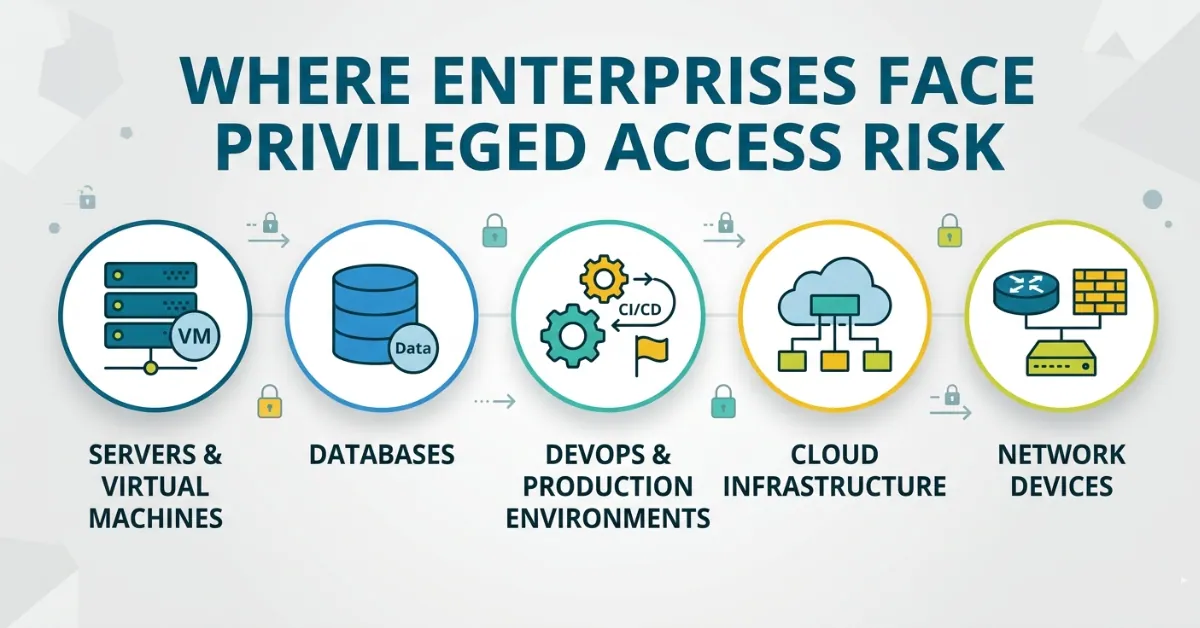
Admins work across cloud consoles, databases, servers, Kubernetes clusters, remote desktops, DevOps pipelines, and third-party tools. AI agents and automation scripts are starting to act inside the same privileged paths.
Recording what happened is no longer enough. Security teams need to know which sessions are risky, why they are risky, and what needs attention first.
That is where private AI session auditing changes the conversation.
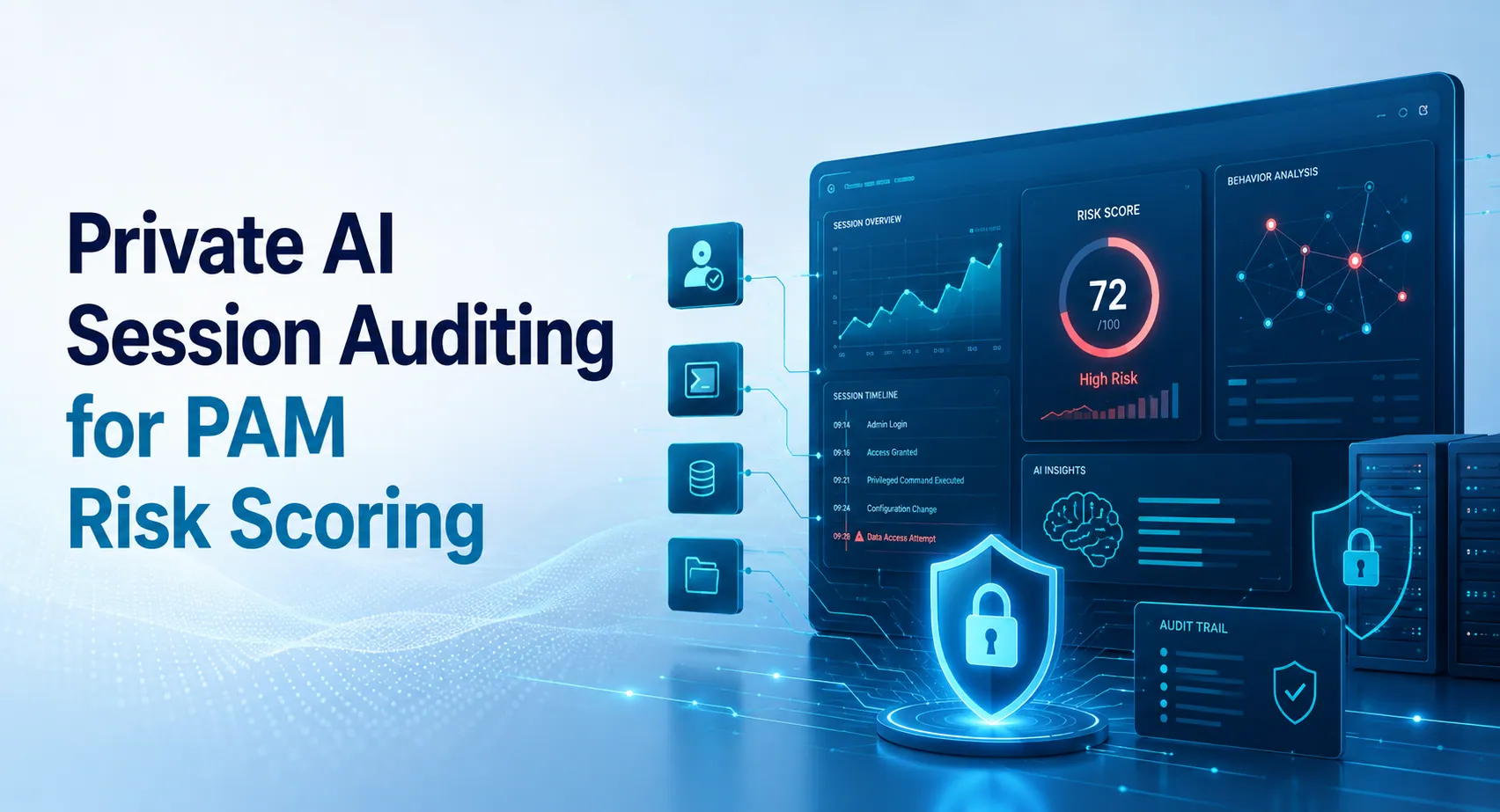
Instead of pushing privileged session data into a third-party AI service, a private AI model can run inside the enterprise boundary. The model reviews session activity, scores risk, explains why a session needs attention, and helps security teams focus on the right evidence.
For regulated industries like healthcare, finance, insurance, government, and critical infrastructure, this matters. Session recordings can contain commands, filenames, system paths, database activity, customer references, configuration details, internal IPs, ticket IDs, user behavior, and operational secrets.
Sending that data out for AI analysis can create a new risk.
Private AI keeps the review closer to the source.
ZenXPAM PAM can support this direction by helping teams think about private AI session auditing, risk scoring, and audit-ready privileged access evidence without unnecessary data egress.
What Private AI Session Auditing Means
Private AI session auditing means privileged session data is reviewed by an AI model that runs inside the enterprise environment or inside a controlled private boundary.
Traditional session review
A session is recorded. A security or audit team reviews it later. In many cases, only a small percentage of sessions are checked because manual review takes too much time.
The result is simple. Most session data exists as evidence, not intelligence.
Private AI session review
The session is analyzed for risk signals, unusual actions, policy mismatch, high-risk commands, access pattern changes, and audit relevance.
The key difference: sensitive session data does not need to leave the enterprise boundary.
Why Cloud-Based AI Auditing Creates a Data Egress Problem
AI can make session auditing faster. But the way AI is deployed matters.
If privileged session data is sent to an external cloud AI service, the organization must answer hard questions.
- What exact session data is leaving the environment?
- Does the data include commands, file paths, customer references, credentials, or system details?
- Where is that data processed?
- Is it stored?
- Who can access it?
- Can the model provider use it for training?
- Does the flow break data residency or compliance expectations?
- Can audit teams prove the data stayed controlled?
These questions are not theoretical. Privileged session data is sensitive by design.
A database admin session may expose table names, queries, exports, error logs, and user references. A cloud admin session may show IAM changes, storage permissions, secrets paths, and production controls. A support session may show customer data. A DevOps session may show deployment steps, scripts, and repo details.
If that data leaves the environment, the audit tool may become a new data exposure path.
That is why private AI is attractive for PAM.
It lets enterprises apply AI-driven review while keeping privileged activity closer to their own controls.
The Four Metrics That Make Session Triage Useful
Private AI session auditing should not only say “risky” or “safe.” It should explain why a session needs attention. A practical model can score sessions across four useful metrics.
Priority
How urgent is the session for review? High-priority sessions may involve production, sensitive data, identity changes, or unusual privilege use.
Effort
How much review work is likely needed? A short, clear session may need less effort. A long, complex session may need deeper investigation.
Confidence
How confident is the model about the risk signal? Low confidence should trigger human review instead of blind automation.
Reasoning
Why was the session flagged? Good scoring should produce clear, audit-friendly reasoning, not a black-box label.
Why PAM Needs Risk Scoring, Not Just Session Recording
Session recording is useful. It gives teams evidence.
But evidence alone does not scale.
A large enterprise may generate thousands of privileged sessions across administrators, vendors, database teams, cloud engineers, service desk teams, and emergency responders.
Reviewing every session manually is not realistic.
So most teams review only what gets escalated, what auditors ask for, or what appears suspicious after another alert fires.
That is a reactive model.
PAM risk scoring changes that model by helping teams triage sessions before they become audit chaos.
A session with no unusual commands, no data export, no privilege change, and no policy mismatch can be marked as lower risk. A session touching sensitive systems, using unusual commands, changing permissions, or moving outside the approved task can be pushed to the top.
The value is focus.
Security teams do not need more footage. They need better signals.
A Private AI Session Auditing Flow
A practical private AI workflow does not replace PAM controls. It strengthens review, scoring, explanation, and evidence.
Capture
Record privileged session activity, commands, metadata, access reason, and approval context.
Keep Local
Keep sensitive session data inside the enterprise boundary or controlled private environment.
Analyze
Use private AI to review risk signals, session patterns, sensitive actions, and policy mismatch.
Score
Assign priority, effort, confidence, and reasoning to guide security and audit review.
Act
Create evidence, escalate risky sessions, support investigation, and improve access policy.
What Should Private AI Look For?
Private AI session auditing should focus on privileged behavior that matters to security teams.
The goal is not to summarize every click.
The goal is to find the moments that change risk.
- Access to production systems outside an approved window
- Privilege escalation or role changes
- Large file downloads or data exports
- Unusual database queries
- Changes to IAM, firewall, logging, or security settings
- Secret or key exposure during a session
- Commands that do not match the approved ticket
- Vendor activity outside expected scope
- Repeated failed attempts or unusual navigation
- Actions taken after emergency access was granted
This is where private AI can help security teams reduce review fatigue.
Instead of asking a person to watch hours of session activity, the system can create a focused risk summary.
The human reviewer still decides.
But the reviewer starts with better context.
Why Explainability Matters in PAM Risk Scoring
A score without explanation is not good enough for privileged access.
If a session is marked high risk, security teams need to know why.
Was it because the admin changed IAM policy? Was it because the user accessed customer data? Was it because the command did not match the approved ticket? Was it because activity happened after business hours? Was it because the session used break-glass access?
Explainability matters because PAM is not only a security tool. It is also an audit tool.
Audit teams need evidence. Security teams need context. Operations teams need fairness.
NIST’s AI Risk Management Framework talks about trustworthy AI characteristics such as secure, resilient, accountable, transparent, explainable, interpretable, and privacy-enhanced AI.
Those principles fit PAM very well.
A private AI model that flags a session should explain the risk in plain language. The explanation should be readable by a security analyst, an IT manager, and an auditor.
Where Private AI Session Auditing Helps Most
Private AI session auditing is most useful where privileged actions are sensitive, frequent, hard to review, and expensive to investigate later.
Regulated industries
Healthcare, finance, insurance, and public sector teams often have strict expectations around data residency, privacy, audit trails, and sensitive operational access.
Vendor access
Third-party users may need temporary access to critical systems. Private AI can help review what happened without exposing session data outside the environment.
Break-glass access
Emergency access should be fast, but it should also be reviewed. AI scoring can help confirm whether the actions matched the emergency reason.
Cloud and DevOps access
Cloud roles, deployment pipelines, and production access can change risk quickly. Session scoring helps teams see which activity deserves review first.
The AI Security Risk You Cannot Ignore
AI brings value to session auditing, but AI itself needs controls.
OWASP’s Top 10 for LLM and Generative AI highlights risks such as prompt injection and sensitive information disclosure. These risks matter in PAM because privileged session context can be sensitive.
A poor design could expose system details, ticket information, credentials, commands, or internal patterns through prompts, logs, outputs, or external model calls.
A better design keeps AI close to the data and limits what the model can see, store, or send.
That is why private AI session auditing should be designed with guardrails:
- Private deployment or controlled local processing
- No unnecessary external model calls
- Prompt and output logging controls
- Role-based access to AI summaries
- Redaction of sensitive fields where needed
- Human review for high-impact decisions
- Clear retention policy for session summaries
- Audit trail for AI-generated findings
AI should not become the newest uncontrolled privileged observer.
It should be governed like the rest of the PAM stack.
Where Zenxsys Fits
Zenxsys helps enterprises rethink PAM for a world where identity, access, automation, and AI are starting to overlap.
ZenXPAM PAM can support a stronger privileged access model built around controlled access, session visibility, audit-ready workflows, and private AI-assisted review.
For security and technology teams, the practical value is simple.
- Review privileged sessions faster
- Score risky sessions using priority, effort, confidence, and reasoning
- Keep sensitive session data inside a controlled environment
- Support audit evidence without exposing operational details to external AI tools
- Improve visibility across admin, vendor, cloud, and emergency access
- Move from passive recording to risk-based session review
The goal is not AI for the sake of AI.
The goal is controlled AI for privileged access.
Continue Reading on Modern PAM
Explore related Zenxsys resources on Zero Standing Privilege, AI agent security, non-human identities, and secure remote access.
ZenXPAM PAM
See how ZenXPAM PAM supports controlled privileged access, visibility, and audit-ready workflows.
BlogZero Standing Privilege
Learn why static admin credentials are dying and how JIT access reduces standing privilege.
BlogAI Agent Security
Understand why AI agents need runtime authorization, intent checks, and stronger access controls.
BlogNon-Human Identity Governance
See why service accounts, API keys, machine identities, and AI agents are the new PAM blind spot.
ServiceManaged Apache Guacamole Access Services
Explore browser-based privileged access for admins, vendors, and remote operations teams.
Frequently Asked Questions
What is private AI session auditing?
Private AI session auditing means privileged session activity is analyzed by an AI model running inside a private or controlled environment. It helps score risk, explain suspicious activity, and create useful audit evidence without sending sensitive session data to an external AI service.
Why does data egress matter in PAM session auditing?
PAM session data can contain commands, system paths, database activity, cloud changes, customer references, and operational details. If that data leaves the environment for AI analysis, it can create privacy, compliance, and security concerns.
How does private AI improve PAM risk scoring?
Private AI can review session behavior and score risk using signals such as sensitive actions, unusual commands, privilege changes, and access context. A practical model can score sessions by priority, effort, confidence, and reasoning.
Does private AI replace human session review?
No. Private AI should help humans review faster. It can highlight risky sessions, summarize key activity, and explain why a session needs attention. Final decisions should stay with security, audit, or operations teams.
Which teams benefit most from private AI session auditing?
Security teams, IAM teams, PAM owners, cloud operations, audit teams, compliance teams, and regulated industries benefit most. It is especially useful where privileged session data is sensitive and manual review does not scale.
How does ZenXPAM PAM fit into private AI session auditing?
ZenXPAM PAM can help teams move toward controlled privileged access, session visibility, risk-based review, and audit-ready evidence. The goal is to support smarter PAM without unnecessary exposure of sensitive session data.
The Path Forward
PAM is moving beyond vaulting and recording.
The next step is risk-aware review.
Security teams need to know which privileged sessions deserve attention, why they matter, and what evidence can support an audit or investigation.
But that intelligence should not require sensitive session data to leave the organization.
Private AI session auditing gives enterprises a better path.
Keep the data controlled.
Score the risk.
Explain the reason.
Review what matters.
That is how PAM becomes more intelligent without creating a new data exposure problem.
Ready to score PAM risk without data egress?
Explore how ZenXPAM PAM can help your team move toward private AI session auditing, risk-based review, and audit-ready privileged access evidence.
Explore ZenXPAM PAMSources
NIST AI Risk Management Framework for trustworthy AI principles.
OWASP Top 10 for LLM and Generative AI for AI security risks such as prompt injection and sensitive information disclosure.
Ollama privacy documentation for local-device processing context.